
Someone on your leadership team asks, “What’s [Competitor X] doing?” And the scramble begins. You pull up their website, skim a press release, check G2 reviews, and cobble together a response in 30 minutes that’s outdated by next week.
That’s not competitive analysis. That’s firefighting.
The average sales rep rates competitive preparedness at just 3.8 out of 10, according to Crayon’s 2025 State of Competitive Intelligence Report. The problem isn’t a lack of effort. It’s a lack of system.
A competitive analysis framework turns ad hoc scrambling into a structured, repeatable process that produces intelligence your team will use. This guide walks you through the exact seven steps to build one, customized for mid-market SaaS teams, with specific time estimates and metrics to prove it’s working.
No MBA required. No 50-slide deck. A framework you can implement this week.
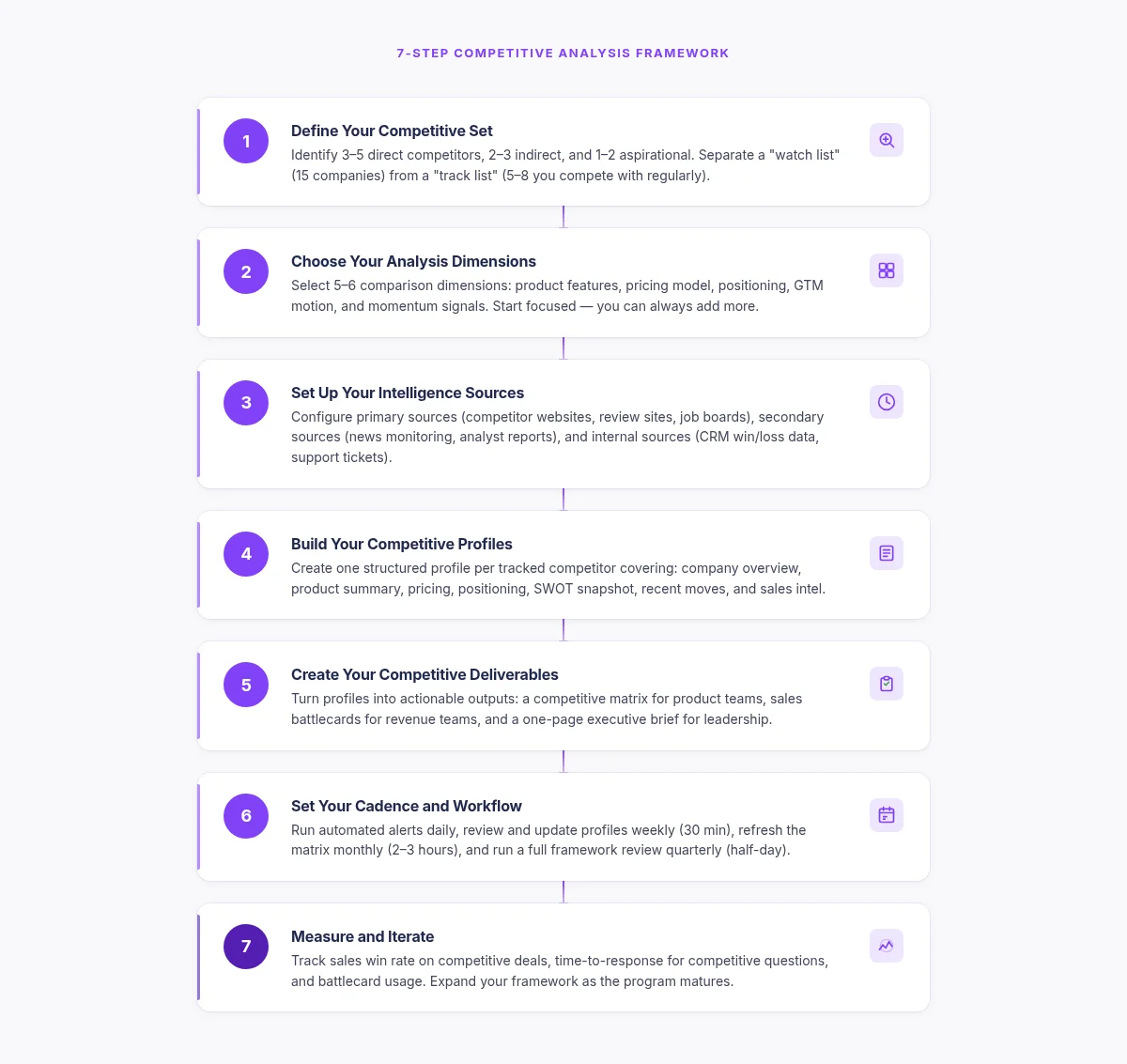
TL;DR — Build Your Framework in 7 Steps
- Define your competitive set — Separate “watch” (10–15 companies) from “track” (5–8 you compete with regularly)
- Choose your analysis dimensions — Start with 5–6: product, pricing, positioning, GTM, momentum, customer base
- Set up intelligence sources — Combine external monitoring with internal goldmines (CRM, support tickets, CS calls)
- Build competitive profiles — One structured profile per tracked competitor, updated monthly
- Create deliverables — Competitive matrix, sales battlecards, executive brief — all actionable, not archival
- Set your cadence — 30 min weekly, 2–3 hours monthly, half-day quarterly
- Measure and iterate — Track win rate on competitive deals, battlecard adoption, and response time
Time to set up: one focused week. Time to see results: one quarter.
What Is a Competitive Analysis Framework?
A competitive analysis framework is a structured, repeatable system for gathering, organizing, and acting on competitive intelligence. It’s not a one-time document or a quarterly slide deck. It’s a process that runs on a cadence and produces outputs your team uses — battlecards, competitive matrices, executive briefs, and pricing alerts.
Most teams confuse frameworks with one-off exercises. They run a SWOT analysis when a new competitor enters the market, build a feature comparison spreadsheet before a board meeting, and call it competitive intelligence. But those are snapshots, not systems.
As Leo Boulton, Head of Competitive Market Strategy at Zoom, describes it: “The simple IO machine is a three-stage process — gathering insights, analysis of all those insights, and disseminating those actionable insights. We build as many programs as we can from a sourcing standpoint so that we can spend most of the time in the analysis stage.”
Classic models like Porter’s Five Forces and SWOT are useful building blocks. But they’re starting points, not complete competitive analysis systems. Porter tells you about industry dynamics. SWOT helps organize strengths and weaknesses. Neither one tells you how often to update your competitive profiles, who owns the battlecards, or what to do when a competitor drops their price by 30% overnight.
This guide synthesizes the best elements into one unified framework you can build step by step.
Step 1 — Define Your Competitive Set
The biggest mistake teams make is trying to track every company that vaguely resembles a competitor. This leads to spreadsheets with 25 rows that nobody updates and nobody trusts.
Start by separating your competitors into three categories: direct competitors (same product, same buyers), indirect competitors (different approach, same problem), and aspirational competitors (market leaders you benchmark against). For a deeper breakdown of each type and how to identify them, see our guide on types of competitors.
A practical starting point: 3–5 direct, 2–3 indirect, and 1–2 aspirational competitors.
The “Watch vs. Track” Distinction
Here’s a distinction most competitive analysis guides miss, and it’s the most important thing to get right before you start building anything.
Your watch list is the broad set of 10–15 companies you monitor at an awareness level. You scan their press releases. You notice when they raise a round. You read their blog posts when they show up in your feed. You don’t build profiles for them.
Your track list is the tight set of 5–8 companies you compete against in deals regularly. These get full competitive profiles, active monitoring, and dedicated battlecards. Every company on this list should be one your sales team encounters in real selling situations.
As one product marketing manager put it on Reddit: “I’m a big believer in separating competitive analysis into current competitors and horizon competitors. You need to have a very strong handle on true alternatives — what customers are actually doing or considering before they choose you. If they’re not currently ending up in your prospects’ consideration set, they shouldn’t get too much of your attention” (u/anotherpmm, r/ProductMarketing).
The heuristic is simple: if they show up in your CRM’s “competitor mentioned” field, they go on the track list. Everyone else goes on the watch list.
Where to find your competitors: G2 and Capterra category pages, Gartner peer comparisons, your own CRM lost-deal data (“who did they leave for?”), and customer churn interviews.
Step 2 — Choose Your Analysis Dimensions
Once you know who to track, decide what to track about them. The dimensions you choose should be driven by your strategic goals — not a generic checklist.
Ben Tutt, Head of Market Insights at BAE Systems, puts it bluntly: “If you aren’t sure what you are going to do with the Intelligence, then the Intelligence will not be useful” (via Octopus Intelligence).
As one practitioner explained on Reddit: “A good analysis depends on what you need the intelligence for. Are you trying to expand your business footprint? Gain credibility for a product? Compare products? These questions matter because the processes can differ significantly” (u/industry-news, r/ProductManagement).
The Core Dimensions Every SaaS Team Needs
Start with these six. They cover the areas that matter most for competitive positioning:
- Product: Feature parity, gaps, unique capabilities, integrations, platform maturity
- Pricing: Model (per-seat, usage-based, flat), tiers, discounting behavior, free tier
- Positioning: Core messaging, ICP, value proposition, tagline, key claims
- Go-to-market (GTM): Sales motion (product-led vs. sales-led), channels, partnerships, content strategy
- Momentum: Funding rounds, hiring patterns, product launches, review velocity on G2
- Customer base: Target segments, notable logos, case studies, geographic focus
Customize Dimensions to Your Market
These six dimensions are a starting point. Adjust based on your vertical. If you sell to regulated industries, add a compliance and certifications dimension. If you’re in a platform play, add ecosystem and integrations. If pricing is the primary competitive battleground, break the pricing dimension into multiple sub-dimensions.
For a detailed guide on how to structure these dimensions in a comparison grid, see our competitive matrix guide.
Pro tip: Start with 5–6 dimensions. You can always add more later — but starting with 15 means you never finish the first round of analysis.
Step 3 — Set Up Your Intelligence Sources
Your competitive analysis framework is only as good as the data flowing into it. Most teams default to Googling the competitor’s name every few weeks. That’s a habit, not a system.
Set up three categories of intelligence sources and you’ll have most of what you need covered.
Primary Sources (Direct Observation)
These are sources you monitor directly:
- Competitor websites and product pages — Track changes to messaging, features, and pricing. For a step-by-step competitor website analysis, archive pricing pages with screenshots or the Wayback Machine.
- G2, Capterra, and TrustRadius reviews — Read recent reviews monthly. Look for patterns in complaints and praise, not just star ratings.
- Job postings — Hiring signals reveal strategic priorities. Five new AI engineers? They’re pivoting to AI. Twelve new enterprise AEs? They’re moving upmarket.
- SEC filings and press releases — For public companies, earnings calls are one of the best sources you’ll find.
And here’s a power-user tactic that most people miss: “Go to Google and search site:competitor.com filetype:pdf confidential. Often you will find public files intended only for customers, their marketing communication, etc. This way, I once found contract information with prices and status updates for an unreleased product” (u/maltelandwehr, r/ProductMarketing — 13 upvotes, highest in thread).
Secondary Sources (Analysis and Commentary)
- Industry analysts — Gartner, Forrester, and IDC for market landscape context
- News monitoring — Google Alerts, Feedly, or dedicated monitoring with CI tools
- Social listening — LinkedIn for executive thought leadership, X/Twitter for product announcements, Reddit for unfiltered user sentiment
Internal Sources (Your Own Data)
This is where most frameworks fall short. Your own teams generate intelligence every day that never makes it into a competitive profile.
Leo Boulton at Zoom calls this the internal-external balance: “On the internal side, we get high volume data that gives us the direction of a driver. When we want the granularity of that feature, we go into the external program. So we get the high volume internally and the external side gives us the finesse and granularity.”
The best internal sources:
- Sales CRM: Win/loss data, competitive mentions in deal notes, objection tracking. As one former Principal Product Marketer at Aircall put it: “Track win/loss. If sales don’t log well, use call recordings like Gong. The worst is when your intel is below what sales or investors already know” (u/ra_intern, r/ProductMarketing).
- Customer success: Churn reasons, feature requests that reference competitors, expansion blockers
- Support tickets: “Does your product do X like [Competitor]?” questions reveal exactly where buyers are comparing you
- Closed-lost interviews: “Prospects that your team was unable to earn business from are typically very open to speak to product management. PMs are not there to ‘sell something’ and that really lowers apprehension” (u/mmorps, r/ProductManagement).
Enrico Vonghia, Director of Markets & Competitive Intelligence at SUEZ Water Technologies & Solutions, makes the same point: “Find different sources to validate your assumptions. Develop process rigour driven by several external data sources” (via Octopus Intelligence). No single source gives you the complete picture.
Step 4 — Build Your Competitive Profiles
A competitive profile is the single source of truth for everything your organization knows about a tracked competitor. Build one per company on your track list.
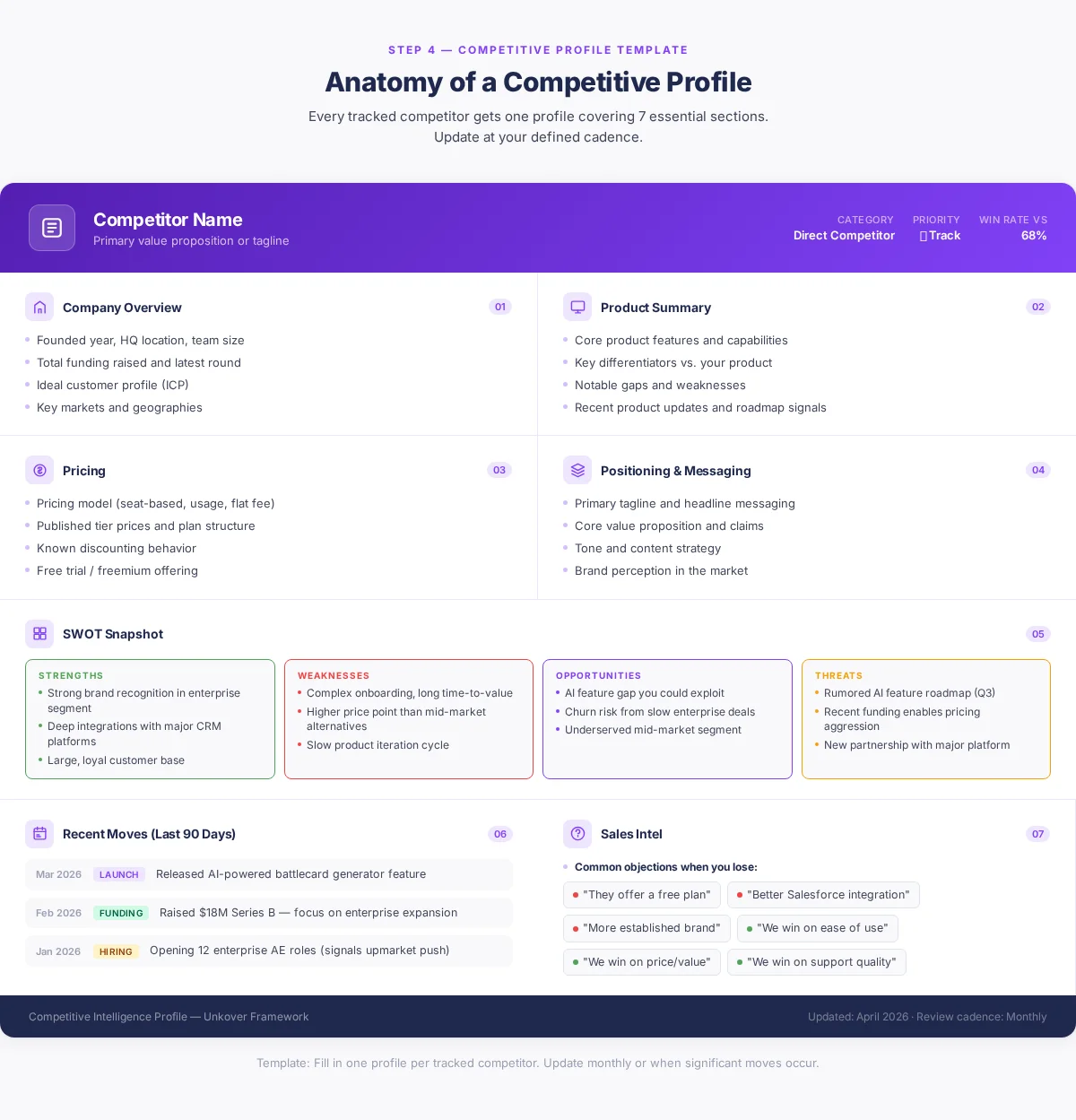
Anatomy of a Competitive Profile
Every profile should include these seven sections:
- Company overview — Size, funding, headquarters, ICP, key leadership, employee count
- Product summary — Core features, differentiators, known weaknesses, platform/tech stack
- Pricing summary — Model, tiers, typical contract value, discounting behavior, free tier details
- Positioning and messaging — Tagline, value proposition, key claims, how they describe themselves vs. how customers describe them
- SWOT snapshot — Strengths, weaknesses, opportunities, and threats relative to your product (not in absolute terms)
- Recent moves — Last 90 days: product launches, hires, partnerships, funding, marketing campaigns, pricing changes
- Sales intel — Common objections when competing head-to-head, win/loss themes, talk tracks that work, and landmines to avoid
The “Recent Moves” section is what keeps profiles alive. Without it, profiles become static documents that nobody trusts because the information is already months out of date.
Where to Store Profiles
Store profiles wherever your team already works — Confluence, Notion, Google Docs, or a dedicated CI platform. The format matters far less than the update cadence.
One practitioner described their entire competitive profiling workflow: “I go to the competitor’s help and developer documentation, get an understanding of how their product works. Then I’ll try it out myself. I’ll review competitive calls to get an understanding of why people are coming to us or leaving. Then I pick my narrative — I create three buckets that express why they are worse than we are, with bullet points underneath. Then translate it into a full competitive battle card. All of this takes me about 6 hours” (u/Palettepilot, r/ProductMarketing).
Six hours per competitor. That’s the real time investment — not the weeks some teams spend on frameworks they never finish.
Step 5 — Create Your Competitive Deliverables
Your framework isn’t done when you’ve gathered intelligence. It’s done when you’ve turned that intelligence into outputs that change how your team makes decisions. If nobody reads the deliverables, the framework failed.
Three core deliverables cover what a mid-market SaaS team needs.
1. Competitive Matrix (For Product and Strategy Teams)
A feature-by-feature comparison grid that shows where you lead, where you’re at parity, and where you trail. This is the artifact product teams use for roadmap prioritization and leadership uses for strategic positioning.
Build it as a living document, not a static table. Update it monthly. For a step-by-step guide on building and maintaining one, see our competitive matrix guide.
2. Sales Battlecards (For Revenue Teams)
A one-page document per competitor with positioning, objection handlers, landmines to set, and proof points. This is what your sales reps pull up mid-call when a prospect says, “We’re also looking at [Competitor].”
The catch: battlecard adoption is the biggest challenge in competitive enablement. Crayon’s 2025 State of Competitive Intelligence Report found that 68% of deals involve at least one direct competitor, yet reps rate their competitive preparedness at just 3.8 out of 10. Battlecards exist — 79% of CI teams create them — but too often they’re too long, too static, or too disconnected from the selling moment. The teams that get battlecards right keep them concise, update them continuously, and embed them in the CRM where reps can pull them up mid-conversation.
For a complete guide on building battlecards that reps use, see our sales battlecards guide.
One Reddit practitioner shared a useful framing test for battlecard positioning: “Boil it down to this very simple positioning claim: ‘If we are competing against XYZ, then one of us is in the wrong place.’ Being able to express this concisely about a competitor and buyer situation is a great way to help sellers and marketers know when and how to compete — and when to walk away” (u/databACE, r/ProductMarketing).
3. Executive Brief (For Leadership)
A monthly or quarterly summary of competitive landscape shifts: who’s growing, who’s struggling, what changed in positioning or pricing, and what it means for your company. Keep it to one page. Executives won’t read a 15-page deck.
The executive brief answers one question: “What changed in our competitive landscape, and what should we do about it?”
The key principle across all three deliverables: actionable, not archival. Every output should trigger a decision or change a behavior. If it sits in a shared drive, it’s noise.
Step 6 — Set Your Cadence and Workflow
A framework without a cadence is a project, not a system. This is where most competitive analysis efforts die. Not because the initial analysis was bad, but because nobody built the habit of keeping it alive.
Recommended Cadence for Mid-Market Teams
| Frequency | Activity | Time Investment |
|---|---|---|
| Daily | Automated alerts (Google Alerts, monitoring tools) | Passive — 5 min scan |
| Weekly | Review alerts, update “Recent Moves” in profiles | 30 minutes |
| Monthly | Refresh competitive matrix, update battlecards, review win/loss data | 2–3 hours |
| Quarterly | Full framework review — add/remove competitors, update all profiles, present executive brief | Half-day |
Fouad Benyoub, Director of Competitive Strategy at Everbridge, warns about the trap of over-committing early: “The thing we all know is about information overload. But the other thing that is also very important is work overload for CI professionals. As soon as you start and if you do a good job, you will have a lot of requests coming from everywhere inside the organization, and it’s always needed for yesterday.”
Start with the cadence above. You can always expand scope once the system is running.
One product management team shared a triage system that keeps the monthly review focused: “We review monthly, not daily: a one-pager with only deltas, tagged ‘ignore / watch / act.’ If a competitor insight doesn’t change a story, a spec, or a playbook, it’s noise” (u/Adventurous-Date9971, r/ProductManagement).
That ignore / watch / act framework is simple and immediately usable. “Ignore” means no response needed. “Watch” means monitor over the next cycle. “Act” means update a deliverable, alert a stakeholder, or adjust a plan.
Who Owns What?
- Product marketing — Competitive profiles, positioning analysis, battlecards
- Sales ops — Win/loss data collection, CRM competitive tagging
- Product — Feature comparison, roadmap alignment
- A single CI owner — Even if competitive analysis is a shared responsibility, assign one person who is accountable for keeping the framework alive
Step 7 — Measure and Iterate
If you can’t prove your competitive analysis framework is working, it will eventually lose budget, headcount, and executive attention. Build measurement in from day one.
Alex Knapik, Competitive Intelligence Lead at Milestone Systems, puts it well: “Organisational adoption is more important than anything. If your business doesn’t change the decisions and actions they make based on your work, it doesn’t mean anything” (via Octopus Intelligence). A framework nobody uses is just a file.
Key Metrics to Track
- Competitive win rate — Your win rate specifically on deals where a competitor was involved. Track this before and after implementing the framework. Research from the Strategic and Competitive Intelligence Professionals (SCIP) found that organizations that systematically track CI ROI see 23% higher revenue growth than those that don’t.
- Time-to-response — When leadership asks a competitive question, how long does it take to deliver an answer? With a working framework, this should drop from days to minutes.
- Battlecard adoption — Are sales reps opening and using the battlecards? Track views and usage in your CRM or enablement platform.
- Reduction in “I don’t know” answers — In competitive deal reviews, how often do reps say they didn’t know about a competitor’s feature or positioning? This should trend toward zero.
Iterate the Framework
Your competitive analysis framework should evolve as your market does. Quarterly reviews are the right time to ask:
- Should any competitors move from the watch list to the track list (or vice versa)?
- Are there new analysis dimensions we need to add based on market shifts?
- Which deliverables are getting used, and which are collecting dust?
- Is the cadence right, or do we need to adjust?
For the broader context on building a full CI program around this framework, see our competitive intelligence pillar guide.
Common Mistakes to Avoid
Even well-designed competitive analysis frameworks fail when teams fall into these traps:
Tracking too many competitors. This is the number-one killer. Trying to deeply profile 15+ companies means every profile is shallow and every update is late. The system collapses under its own weight. Pick 5–8 for your track list. Be ruthless.
Building a framework nobody uses. Harvard Business Review found that only 50% of companies use the competitive intelligence they collect. The problem is almost always the same: the intelligence is too theoretical, too long, or disconnected from the decisions people need to make. Every deliverable should answer “so what?” — if it doesn’t change a decision, cut it.
Updating quarterly instead of continuously. Competitive intelligence older than six months is largely outdated. A framework that only gets refreshed once a quarter will always feel stale. The weekly 30-minute check-in is what keeps the system alive between deep-dive reviews.
Focusing only on product features. Feature-by-feature comparisons are table stakes. The teams that win also track positioning shifts, GTM changes, hiring patterns, and customer sentiment. A competitor hiring 10 enterprise AEs tells you more about their strategy than a new feature release.
Not connecting CI to sales outcomes. If your competitive analysis doesn’t influence win rates, it’s academic. The gap between insight and action is where most programs fail. Build the feedback loop from day one: battlecards in the CRM, win/loss reviews with competitive tags, and regular syncs between product marketing and sales.
Treating it as a one-person job. Product marketing may own the framework, but the best input comes from sales (deal-level intelligence), customer success (churn drivers), support (competitive comparison questions), and product (feature parity assessment). Create channels for this input to flow in continuously.
Conclusion
A competitive analysis framework isn’t a one-time project. It’s a system that compounds over time. Each cycle makes your profiles sharper, your battlecards more accurate, and your competitive calls easier to win.
Start simple: five competitors on your track list, 5–6 analysis dimensions, and a monthly cadence. Implement the weekly 30-minute check-in to keep profiles current. Build battlecards that reps can pull up mid-call. Present a one-page executive brief each quarter.
The teams that treat competitive analysis as a repeatable process, not a fire drill, are the ones that consistently win competitive deals.
Your competitors aren’t standing still. Your framework shouldn’t either.
Subscribe to the Unkover newsletter for weekly CI frameworks, templates, and tool reviews.