
Your competitors updated their pricing page last week. They posted three new job listings for “AI product managers.” And their CEO just gave a podcast interview hinting at a new enterprise tier. If you missed all of that, you’re running blind.
Most SaaS companies treat competitive intelligence as a reactive exercise—panic-Googling before a board meeting or scrambling for intel after losing a deal. 68% of B2B deals now involve at least one direct competitor, according to Crayon’s 2025 State of Competitive Intelligence report. Yet the average sales team rates its own competitive preparedness at just 3.8 out of 10.
That gap between competitive pressure and competitive readiness costs real money—an estimated $2 to $10 million per year in winnable deals, according to the same Crayon research.
This guide covers everything you need to build a repeatable competitive intelligence process—from defining what to collect, to where to find it, how to analyze it, and how to turn raw data into deliverables that actually drive decisions. No enterprise CI platform required. No dedicated analyst headcount. Just a practical framework built for B2B SaaS teams running lean.
TL;DR — Key Takeaways
- Competitive intelligence (CI) is the systematic process of gathering, analyzing, and acting on information about your competitors and market to make better business decisions.
- CI is not spying. It uses only legal, publicly available sources. It’s also not a one-time analysis—it’s an ongoing, structured practice.
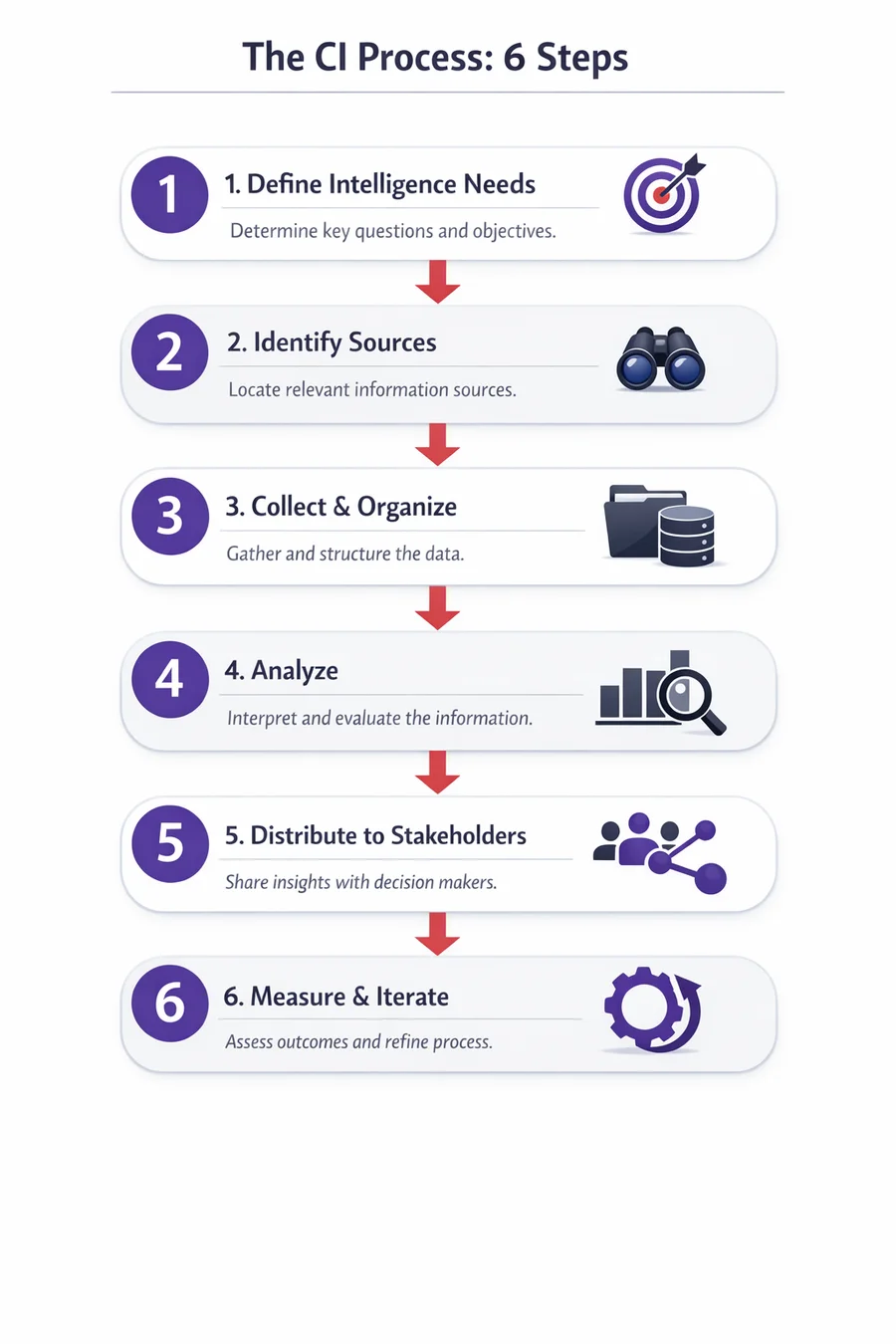
- The 6-step CI process: define intelligence needs → identify sources → collect and organize → analyze → distribute to stakeholders → measure and iterate.
- SaaS-specific sources (pricing pages, G2 reviews, product changelogs, job postings) are often more valuable than traditional market research.
- You don’t need a $50K CI platform to start. The best programs begin with free tools, a consistent cadence, and a single owner who cares.
What Is Competitive Intelligence?
Competitive intelligence (CI) is the systematic process of gathering, analyzing, and acting on information about your competitors, market, and industry to make better business decisions.
That definition has three critical parts. CI is systematic—not ad hoc Googling when your CEO asks “what’s our competitor doing?” It’s analytical—raw data without interpretation is noise, not intelligence. And it’s actionable—if it doesn’t lead to a better decision, it’s just trivia.
What CI Is Not
CI is legal. It relies exclusively on publicly available sources—websites, reviews, job postings, press releases, SEC filings, social media, and information that customers or prospects voluntarily share. Industrial espionage, hacking, misrepresentation, and stealing proprietary information have nothing to do with competitive intelligence. The Strategic and Competitive Intelligence Professionals (SCIP) organization maintains a formal code of ethics that the CI profession operates under.
CI was once the province of Fortune 500 strategy departments with six-figure research budgets. Today, it’s something every SaaS team needs—and most still don’t do well.
CI vs. Competitive Analysis vs. Market Research
These terms get used interchangeably, but they’re not the same:
| Competitive Intelligence | Competitive Analysis | Market Research | |
|---|---|---|---|
| Scope | Competitors + market + industry trends | Specific competitor comparison | Customer needs + market size |
| Timeframe | Ongoing, continuous | Point-in-time snapshot | Project-based |
| Focus | Forward-looking (what’s coming next?) | Current state (where do we stand?) | Customer-centric (what do buyers want?) |
| Output | Battle cards, reports, dashboards, alerts | SWOT matrices, feature comparisons | Surveys, personas, TAM analysis |
| Who uses it | Sales, product, marketing, leadership | Product marketing, strategy | Product, marketing |
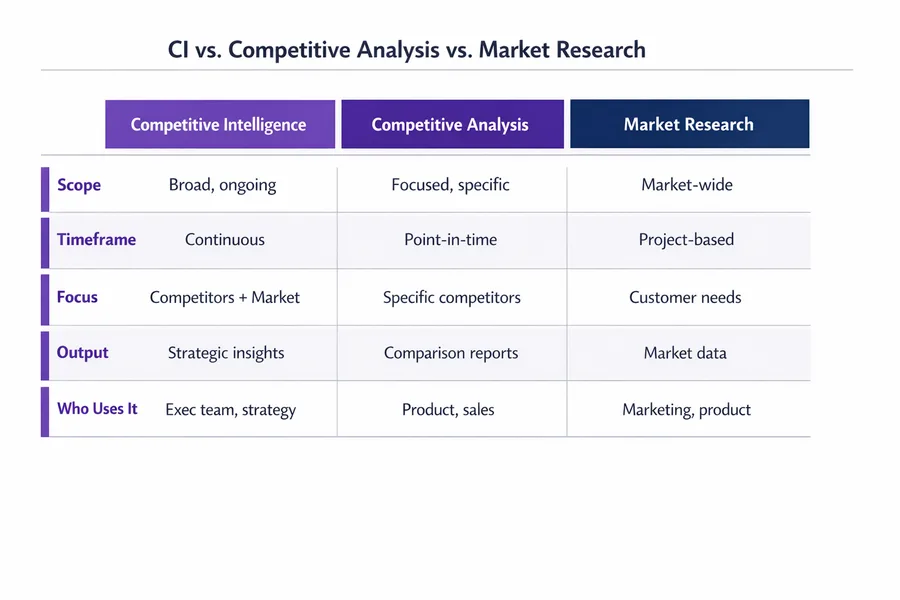
Competitive analysis is something you do within a CI program. Market research tells you about your buyers. Competitive intelligence tells you about the landscape those buyers are navigating—and how to win within it.
Why Competitive Intelligence Matters for SaaS Teams
Competitors are multiplying. 90% of businesses report their industry has become more competitive in the last three years, according to a joint SCIP and Crayon study. If you’re in B2B SaaS, you feel this acutely—competitors ship features weekly, change pricing quarterly, and pivot messaging with every trend cycle. Without a CI practice, you’re making decisions based on assumptions that are already outdated.
Here’s why CI earns its place on your priority list:
1. Win more competitive deals. When reps walk into calls armed with battle cards, objection handlers, and positioning that addresses specific competitor weaknesses, they close more. 71% of businesses using battle cards report improved win rates, according to Crayon.
2. Spot market shifts before they hit. A competitor suddenly hiring five machine learning engineers? That’s a product pivot signal you can see in job postings three to six months before any press release. Competitor pricing changes, new integration partnerships, and executive departures are all signals that CI programs catch early.
3. Build better products. Mining competitor reviews on G2 and Capterra reveals what their customers love and what drives them to look for alternatives. That’s free product research—straight from users who match your ideal customer profile.
4. Position your marketing effectively. If every competitor claims “all-in-one,” you can own “purpose-built.” If they lead with features, you lead with outcomes. CI turns competitive positioning from guesswork into strategy.
5. Make smarter strategic decisions. From pricing to partnerships to market entry, CI grounds strategy in evidence rather than intuition. 61% of businesses with formal CI programs reported that CI directly impacted revenue—and that number jumped to 78% among companies that set defined CI KPIs, according to the same Crayon research.
The 4 Types of Competitive Intelligence
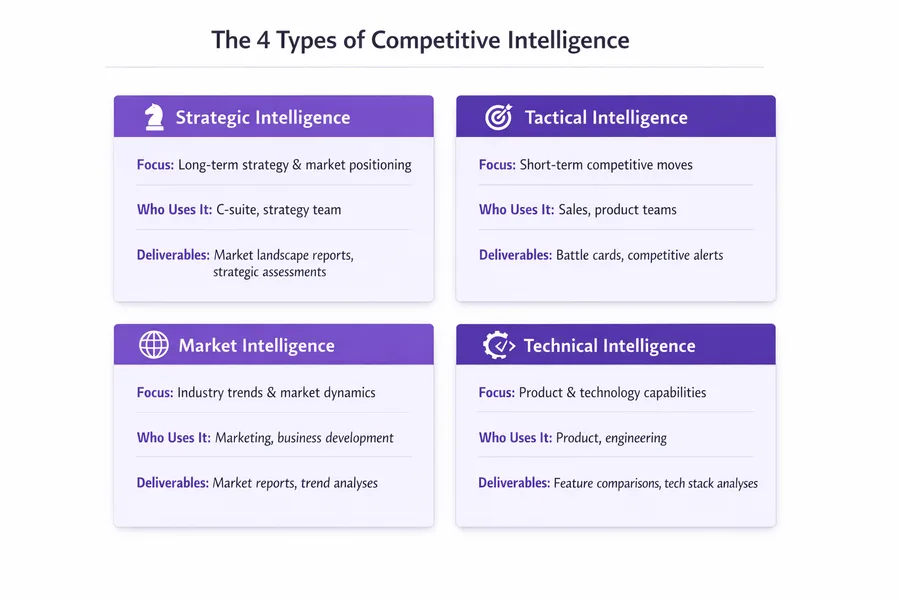
Not all intelligence serves the same purpose. Understanding these four types helps you focus limited resources on what your team actually needs.
| Type | Focus | Used by | Typical Deliverables |
|---|---|---|---|
| Strategic | Long-term trends, competitor strategy, market shifts | Leadership, board, strategy | Market landscape reports, strategic briefings |
| Tactical | Short-term moves: pricing, features, campaigns | Product marketing, sales, growth | Battle cards, competitive one-pagers, deal intel |
| Market | Industry dynamics, regulatory changes, emerging tech | Strategy, product, executives | Trend reports, opportunity analyses |
| Technical | Tech stack, APIs, integrations, product architecture | Product, engineering | Technical comparisons, integration maps |
1. Strategic Intelligence
Long-term intelligence about market trends, competitor strategies, and industry shifts. This is what leadership and your board need for planning.
SaaS example: Tracking a competitor’s Series D funding announcement, their expansion into a new vertical, or a CEO keynote where they signal a shift from point solution to platform play.
2. Tactical Intelligence
Short-term competitive moves—feature releases, pricing changes, campaign launches, new messaging. This is what your sales and product marketing teams need now.
SaaS example: A competitor drops their entry-level pricing by 30%, adds a free tier, or launches a feature that was previously your key differentiator. Your sales team needs updated positioning by Monday.
3. Market Intelligence
Broader market dynamics—industry trends, regulatory changes, technology shifts, and buyer behavior patterns. This overlaps with CI but casts a wider net.
SaaS example: A regulatory change creates compliance requirements your competitor hasn’t addressed. Or enterprise AI adoption is shifting how your buyers evaluate solutions—creating positioning opportunities.
4. Technical Intelligence
Product and technology deep-dives—competitor tech stacks, API capabilities, integrations, performance, and architecture decisions.
SaaS example: Using BuiltWith to discover a competitor migrated from a monolith to microservices, or that they added Snowflake and dbt to their stack—signaling a data product play.
How to Do Competitive Intelligence: The 6-Step Process
This is where most CI guides go wrong. They describe what to collect but not how to build a process that fits into a team already stretched thin. Here’s the complete framework, built for SaaS teams without a dedicated CI analyst.
Step 1: Define Your Intelligence Needs
Start with questions, not data. The single biggest CI mistake is collecting everything and analyzing nothing. Before you open a single competitor’s website, answer these:
- What decisions does this intelligence need to inform? Pricing changes? Product roadmap? Sales positioning? Marketing messaging?
- Who will consume it? Sales needs battle cards. Product needs feature comparisons. Leadership needs strategic overviews. Each audience requires different formats.
- Which competitors actually matter? Don’t track every company in your space. Focus on three to five competitors that show up in deals, that prospects mention by name, or that your sales team loses to most frequently. Our guide to types of competitors covers how to identify and prioritize direct, indirect, and emerging competitors.
Define three to five Key Intelligence Topics (KITs)—the areas where intelligence has the most impact. For most SaaS teams: pricing and packaging, product roadmap signals, go-to-market strategy, competitive messaging, and team growth patterns.
Step 2: Identify Your Intelligence Sources
The best CI comes from combining multiple source types. No single source tells the full story.
| Source Type | Examples | What They Reveal |
|---|---|---|
| Primary (direct) | Competitor websites, product demos, free trials, industry events, your own sales team | Pricing, features, positioning, roadmap signals |
| Secondary (third-party) | G2/Capterra reviews, LinkedIn, press releases, podcasts, SEC filings | Reputation, team growth, strategy, financial health |
| SaaS-specific | Product changelogs, job postings, pricing page archives, integration marketplaces, developer docs | Product direction, hiring strategy, pricing evolution, partnership signals |
Primary sources—direct observation:
- Competitor websites—pricing, product pages, case studies, careers sections
- Product demos and free trials—firsthand product experience beats secondhand descriptions
- Industry events and webinars—presentations reveal positioning and roadmap hints
- Your sales team—reps hear competitor messaging from prospects every single day
Secondary sources—third-party data:
- G2, Capterra, TrustRadius reviews—filter by one and two-star reviews to find recurring complaints (your competitive advantages). Filter by five-star reviews to understand real strengths.
- LinkedIn—track team growth, key hires, and departures. A competitor hiring a “Head of Enterprise Sales” tells you where they’re headed.
- Press releases and funding announcements—reveal strategic priorities and financial health.
- Podcast interviews and conference talks—executives share candid insights that rarely appear in marketing materials.
SaaS-specific sources—where the gold is:
- Product changelogs and release notes—most SaaS companies publish these publicly. Subscribe to every competitor’s changelog.
- Job postings—hiring patterns reveal strategy three to six months before any announcement. Ten new “AI engineer” roles? That’s a product pivot signal.
- Pricing page archives—use the Wayback Machine to track how competitor pricing evolves over time.
- Integration marketplace listings—new integrations signal partnership strategies and target market expansion.
- Developer documentation changes—API doc updates reveal product direction faster than marketing pages.
Step 3: Collect and Organize Intelligence
Raw intelligence without organization becomes noise. Set up a system before you start collecting.
Establish a cadence. Not everything needs daily monitoring:
| Frequency | What to Monitor |
|---|---|
| Weekly | Competitor pricing pages, new G2/Capterra reviews, job postings, product changelogs |
| Monthly | Messaging and positioning changes, content strategy shifts, LinkedIn team growth, integration announcements |
| Quarterly | Full competitive landscape review, strategic intelligence assessment, market trend analysis |
Organize by competitor, then by topic. A simple folder structure works: one folder per competitor, with subfolders for pricing, product, messaging, team, and strategy. Google Drive, Notion, or Confluence all work fine. The tool matters far less than the consistency.
Pro tip: Create a shared Slack channel (#competitive-intel) where anyone can drop competitive observations in real time. A rep overhears a competitor’s name on a call? Post it. Marketing spots a competitor’s new ad campaign? Post it. This crowdsourced feed becomes one of your most valuable intelligence sources—and costs nothing.
As your CI program scales, AI can automate much of the collection and analysis work in Steps 2–4. See our guide to AI competitive intelligence for the 4-layer AI CI tech stack, a five-level maturity model, and a step-by-step implementation plan.
Step 4: Analyze What You’ve Found
Collection without analysis is hoarding. For every piece of intelligence, ask: “So what? What does this mean for us?”
Use these frameworks to turn raw data into insight:
- SWOT per competitor—map strengths, weaknesses, opportunities, and threats for each competitor you track. Update these quarterly.
- Win/loss pattern analysis—why are you winning or losing against specific competitors? Your CRM data and post-deal interviews reveal patterns that individual observations can’t.
- Messaging comparison—how does each competitor position themselves? Where’s the gap between their marketing claims and their actual product capabilities? Building a competitive matrix helps you visualize these comparisons side by side.
- Feature gap analysis—what capabilities do competitors have that you don’t? What do you have that they can’t match?
How to separate signal from noise. Not every competitor move is significant. A homepage redesign is cosmetic. A pricing restructure is strategic. Focus your analysis on changes that affect competitive positioning: pricing moves, feature launches that close your differentiators, messaging pivots toward your target market, and key executive hires.
Red flags that deserve immediate attention:
- Mass hiring in a new function (e.g., a competitor with no enterprise team suddenly posting 10 enterprise AE roles)
- Significant price drop or introduction of a free tier
- Messaging pivot away from their core value proposition
- Acquisition of a company in your space
- Departure of multiple key executives within a short window
Step 5: Distribute Intelligence to Stakeholders
The number one CI failure: brilliant intelligence that sits in a folder nobody opens.
Match the format to the audience, and put intelligence where stakeholders already work:
- Sales → Battle cards and competitive one-pagers embedded in CRM opportunity records. Our sales battle cards guide walks through how to build them. For a broader look at what sales teams need, see our guide to sales enablement materials.
- Product → Feature comparison matrices and customer feedback synthesis linked from your product management tool.
- Leadership → Quarterly competitive intelligence reports with strategic implications and recommended actions.
- Marketing → Messaging differentiation guides and positioning documents in your shared marketing workspace.
Distribution channels that actually work:
- Slack: Weekly competitive digest in a dedicated channel. Pin battle cards for quick retrieval.
- CRM: Embed competitive intel on competitor accounts and opportunity records so reps see it during deal prep.
- All-hands: Quarterly competitive landscape presentation—15 minutes that keeps the entire company informed.
- Living documents: Wiki-based battle cards and competitor profiles that update continuously, not static PDFs that go stale.
Step 6: Measure and Iterate
If you can’t measure CI impact, it’s hard to justify the time investment. Track these metrics:
- Competitive win rate—are you winning more deals against specific competitors? This is the most direct CI ROI metric.
- Battle card usage—are reps actually opening and referencing competitive content? 79% of CI professionals produce battle cards, but only 26% say reps use them enough, according to Crayon’s research. If your team isn’t using them, the problem is distribution or relevance—not the concept.
- Stakeholder feedback—run a quarterly survey: “Is the competitive intel you receive useful? What’s missing? What format works best?”
- Time to response—when a competitor makes a major move, how fast can your team produce an updated battle card, revised positioning, or a sales alert?
Review your intelligence priorities quarterly. The competitors that matter shift over time. A new entrant may become your biggest threat. An old rival may pivot out of your market. Adjust your focus based on deal data and market dynamics, not inertia.
Companies that take measurement seriously see the difference. 78% of businesses with defined CI KPIs reported direct revenue impact, compared to just 20% of those without KPIs—making the case that structured CI isn’t just useful, it’s measurable.
Theory is useful. Examples make it concrete. Here are five scenarios showing competitive intelligence in action for SaaS teams. Company names are fictional—the patterns are real.
Example 1: Job postings reveal a product pivot.
A project management SaaS noticed its primary competitor posted 12 machine learning engineer roles in a single month—up from zero the prior quarter. Six weeks later, that competitor announced “AI-powered project forecasting.” Because the CI team caught the hiring signal early, the product team had already accelerated its own AI roadmap and marketing had positioning ready for launch day. The intelligence source cost nothing: a weekly scan of the competitor’s careers page.
Example 2: G2 reviews build objection handlers.
A marketing automation platform systematically mined 200+ competitor reviews on G2, filtering by one and two-star ratings. Three recurring themes emerged: poor customer support (mentioned in 34% of negative reviews), complex onboarding (28%), and unreliable reporting (22%). The CI owner turned these into objection-handling talk tracks for sales reps. In the following quarter, competitive win rate against that specific rival increased by 15%.
Example 3: Pricing page monitoring prevents a surprise.
A CRM vendor set up weekly Wayback Machine checks on three competitors’ pricing pages. When one competitor quietly dropped its starter tier from $79/seat to $49/seat, the CI team flagged it within a week—before most customers had noticed. Sales had updated competitive positioning within 48 hours, and marketing launched a total-cost-of-ownership comparison highlighting features included at their price point. For more patterns like these, explore our competitive intelligence examples collection.
Example 4: Content analysis reveals a messaging shift.
An analytics SaaS tracked its competitor’s blog output for six months and spotted a clear pattern: 70% of new content shifted from “data analytics” to “AI-driven insights.” This signaled a full brand repositioning. Armed with this intelligence, the marketing team doubled down on “human-first analytics” positioning—a deliberate contrast that resonated with buyers skeptical of overpromised AI capabilities.
Example 5: LinkedIn tracking spots organizational changes.
A sales enablement platform monitored a competitor’s team on LinkedIn. Over three months, the competitor’s VP of Customer Success departed, two senior CSMs left, and no replacements were hired. Meanwhile, aggressive outbound SDR hiring ramped up. The intelligence suggested a strategic shift from retention to acquisition—meaning their existing customers were likely underserved. The sales team began targeting those customers with retention-focused messaging and closed three competitive switches in one quarter.
Competitive Intelligence Tools: A Quick Overview
You don’t need an enterprise CI platform to build an effective program. Only 25% of companies have CI teams of three or more people, according to Crayon’s 2024 research—meaning most teams are running CI with limited resources and general-purpose tools.
Here’s how the tool landscape breaks down:
- Website monitoring: Visualping or ChangeTower track competitor website changes automatically—pricing, features, messaging. Start with free tiers.
- Review aggregation: G2, Capterra, and TrustRadius are free to browse. Set up alerts for new competitor reviews. This is one of the most underused CI sources.
- CI platforms: Klue, Crayon, and Kompyte offer dedicated competitive intelligence platforms with automated collection, battle card builders, and analytics. These typically run $15K-$50K+/year—a fit for teams with proven CI demand and budget to match.
- Free alternatives that work: Google Alerts for competitor mentions, LinkedIn for team tracking, the Wayback Machine for pricing history, and a shared Notion database or spreadsheet for organizing everything. Most teams should start here and upgrade only when volume justifies paid tooling.
It’s worth noting that AI is changing CI workflows fast. 76% of compete teams increased their AI adoption year-over-year, and 60% now use AI tools daily, according to Crayon’s 2025 report. AI won’t replace the strategic thinking behind CI, but it’s dramatically accelerating how teams collect, summarize, and distribute competitive intel.
The CI tools market is projected to grow from $590 million in 2025 to $1.46 billion by 2030, according to Mordor Intelligence—nearly 20% annual growth. We’ll publish a detailed comparison of the best CI tools for 2026 soon. Subscribe to get notified when it’s live.
Common Competitive Intelligence Mistakes
Even teams that invest in CI fall into predictable traps. Here are the five most common—and how to avoid them.
1. Collecting without analyzing. “Intelligence hoarding” is the CI equivalent of subscribing to 50 newsletters and reading none. If you’re tracking 20 data sources but can’t answer “what is our top competitor’s biggest weakness?”—you have a collection problem, not an intelligence program.
2. Tracking too many competitors. Focus on the three to five competitors that actually show up in your deals. The well-funded startup that hasn’t launched yet or the legacy player you never compete against? They can wait. Spreading CI effort across 15 competitors means doing all of them poorly.
3. Only doing CI reactively. If competitive intelligence only happens before board meetings or after losing a deal, you’re always a step behind. The teams that win do CI on a cadence—weekly monitoring, monthly analysis, quarterly strategic reviews. Proactive CI is a habit, not a project.
4. Confusing opinion with intelligence. “I think their product is worse than ours” is an opinion. “Their product has a 3.2/5 support rating on G2, with 38% of negative reviews citing slow response times” is intelligence. Source your claims. Verify your assumptions. Let data drive your competitive positioning.
5. Not distributing to stakeholders. A single person who knows everything about competitors but never shares it is a bottleneck, not a CI program. If sales doesn’t have battle cards, product doesn’t see competitive feature data, and leadership doesn’t get strategic updates—all that intelligence is wasted. The research confirms this failure is widespread: 44% of companies still lack visibility into which competitors appear in their CRM pipeline, according to Crayon’s 2025 report.
Key Takeaways
- Competitive intelligence is a process, not a project. CI is ongoing, systematic, and forward-looking—not a one-time competitive analysis before a board meeting.
- Start with questions, not data. Define what decisions CI needs to inform and who will consume it before you start collecting.
- SaaS-specific sources are your edge. Pricing pages, G2 reviews, job postings, product changelogs, and integration marketplaces reveal more about competitor strategy than traditional market research ever will.
- Follow the 6-step process at any scale. Define needs → identify sources → collect and organize → analyze → distribute → measure. This framework works whether you have a team of one or a dedicated CI function.
- Distribution is where most programs fail. The best intelligence in the world is worthless if it sits in a folder nobody opens. Put intel where stakeholders already work—CRM, Slack, and living documents.
- Measure what matters. Companies with defined CI KPIs are nearly four times more likely to report direct revenue impact. Track competitive win rates, battle card usage, and stakeholder satisfaction.
Read next: Sales Battle Cards: The Complete Guide + Templates—learn how to turn competitive intelligence into the #1 deliverable sales teams actually use.
Subscribe to the Unkover newsletter for weekly competitive intelligence insights, frameworks, and tool recommendations delivered to your inbox.