
Sellers encounter competitors in 68% of deals, according to Crayon’s 2025 State of Competitive Intelligence report. That means in nearly seven out of 10 opportunities, your reps are going head-to-head against alternatives—and the teams that win aren’t necessarily selling the better product. They’re better prepared.
The problem? Most sales teams either don’t have battle cards, or they’re working with outdated ones buried in a shared drive that nobody opens. 79% of CI professionals say they produce battle cards for their sales teams, according to Crayon’s State of CI research—yet only 26% report that reps actually use them enough.
This guide fixes that gap. You’ll learn what a battle card is, what to include, how to build one from scratch using real competitive intelligence, and how to keep it updated so it doesn’t become shelfware. We also include a ready-to-use template you can copy today—no email gate, no sign-up required.
TL;DR — Key Takeaways
- A battle card is a concise, one-to-two-page reference that arms sales reps with competitive intelligence for live deal conversations.
- 71% of companies using battle cards report increased win rates—and 93% of those say the increase exceeds 20%.
- Effective battle cards focus on positioning, objection handling, and trap-setting questions—not just feature comparisons.
- The biggest reason battle cards fail isn’t bad content—it’s lack of maintenance and poor distribution. Set a monthly refresh cadence and put them where reps already work.
- Scroll down for a complete, free battle card template with a filled-in example.
What Is a Sales Battle Card?
A battle card (also written as “battlecard”) is a concise, one-to-two-page reference document that gives sales reps the competitive intelligence they need for specific selling situations. Think of it as a tactical cheat sheet for competitive deals—quick to scan, easy to reference mid-call, and focused on what to say rather than what to know.
A battle card is not a product brochure, a full competitive analysis report, or a feature comparison spreadsheet. Those serve different purposes. A battle card is a tactical tool designed for speed—a rep should be able to pull it up in seconds and find the exact talking point they need. (You might hear people use “cheat sheet” and “battle card” interchangeably, but a true battle card is structured around a specific competitor or selling scenario, while a cheat sheet tends to be a broader reference for general product knowledge.)
Who uses them: Account executives (AEs), business development reps (BDRs), sales development reps (SDRs), and sales managers. Customer success teams increasingly use them for renewal conversations where competitors try to poach accounts.
Where they live: The best battle cards live where your reps already work—inside your CRM (Salesforce, HubSpot), pinned in Slack channels, embedded in your internal wiki (Notion, Confluence), or hosted on a dedicated CI platform like Klue or Crayon.
Why Battle Cards Win Deals
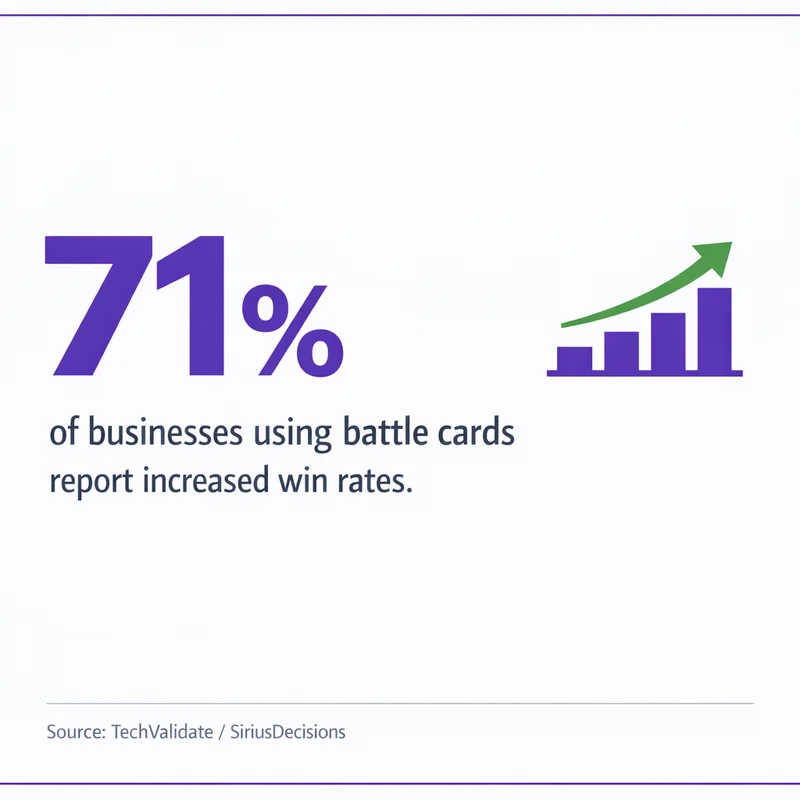
The data on battle card effectiveness is compelling. 71% of businesses using battle cards report increased win rates, according to Crayon. Of those, 93% say the increase exceeds 20%.
Here’s why they work:
1. They reduce ramp time for new reps. New hires don’t need months of tribal knowledge to handle competitive objections. A good battle card gives them the positioning, proof points, and talk tracks they need from day one. Sales organizations with structured enablement content report 27.1% higher win rates than those without, according to CSO Insights.
2. They standardize competitive positioning across the team. Without battle cards, every rep improvises their own response to “Why should I choose you over [Competitor]?” Some nail it. Most don’t. Battle cards ensure your best competitive arguments reach every rep, not just the top performers.
3. They shift reps from reactive to proactive. Instead of stumbling when a prospect mentions a competitor, reps can proactively set traps—asking questions that expose competitor weaknesses before the prospect even brings them up.
A quick scenario: An AE is on a discovery call and the prospect mentions they’re also evaluating a competitor. Without a battle card, the rep either fumbles through a generic response or promises to “get back to them with a comparison.” With a battle card, the rep pivots immediately: “Great question. Most teams evaluating [Competitor] ask us about X—here’s what you should know…” The deal stays on track. The rep looks prepared and credible.
The 6 Types of Sales Battle Cards
Not every battle card serves the same purpose. Here are the six types that cover most competitive selling scenarios:
1. Competitor Battle Cards
The most common type. A head-to-head comparison against a specific competitor covering their positioning, strengths, weaknesses, objection handlers, and trap-setting questions. Build one for every competitor you regularly face in deals—most teams need three to five.
2. Objection-Handling Cards
Focused entirely on the most common objections your reps hear: “You’re too expensive,” “We already have a solution,” “Competitor X has [feature] and you don’t.” Each entry lists the objection, why it comes up, and a recommended response with supporting evidence.
3. Feature Comparison Cards
A side-by-side feature matrix for competitive deals where the buyer is focused on capabilities. Useful for technical evaluations, but don’t rely on these alone—feature comparisons without context and positioning tend to commoditize the conversation. For guidance on structuring these effectively, see our guide to building effective comparison pages.
4. Industry/Vertical Cards
Tailored competitive positioning for specific verticals. A battle card for selling into healthcare looks different from one targeting fintech—the compliance requirements, buyer priorities, and competitive landscape all shift. Create these when you have meaningful traction in two or more verticals.
5. Persona-Based Cards
Different messaging for different buyer personas. The CTO cares about integration architecture and security. The CMO cares about time-to-value and reporting. Procurement cares about total cost of ownership. Persona cards help reps adjust competitive messaging to the audience in the room.
6. Win/Loss Cards
Built from actual deal outcomes—what worked, what didn’t, and patterns to replicate or avoid. These are often the most honest battle cards because they’re grounded in real results rather than theoretical positioning. Sourced from win/loss interviews, CRM data, and deal post-mortems.
What to Include in a Battle Card
Every effective battle card follows a consistent anatomy. Here are the essential sections:
- Competitor snapshot: Company name, founded date, employee count, funding, and target market segment. Keep it to two or three lines—this is context, not the main event.
- Their positioning vs. yours: How the competitor positions themselves, and how your positioning differs. Use their actual messaging, not your interpretation of it.
- Strengths (honest assessment): What they genuinely do well. Reps lose credibility if they pretend competitors have no strengths. Acknowledge them—then pivot to where you win.
- Weaknesses (factual, not FUD): Where they fall short, backed by evidence—customer reviews on G2, product gaps you’ve verified, analyst reports. Never make claims you can’t substantiate.
- Top three to five objections + responses: The most common objections reps hear in deals against this competitor, with specific talk-track responses. Each response should include a supporting proof point (case study, data, customer quote).
- Trap-setting questions: Questions reps can ask that expose competitor weaknesses before the competitor is even mentioned. Example: “How does your current solution handle [specific use case]?”—if the competitor can’t handle it well, the prospect discovers the gap themselves.
- Pricing intelligence: What you know about their pricing model, typical deal sizes, and discounting behavior. Include guidance on how to position against their pricing.
- Proof points: Customer references, case studies, or data points that support your competitive advantages.
Formatting rules that matter:
- One page, maximum two. If it’s longer, reps won’t use it. Ruthlessly cut anything that doesn’t directly help close a deal.
- Bullets, not paragraphs. Reps are scanning mid-conversation, not reading an essay.
- Make it scannable. Bold the key phrases. Use clear section headers. A rep should find what they need in under 10 seconds.
How to Build a Battle Card in 5 Steps
This is where most guides fall short—they tell you what to include but not how to gather the intelligence. Here’s the complete process.
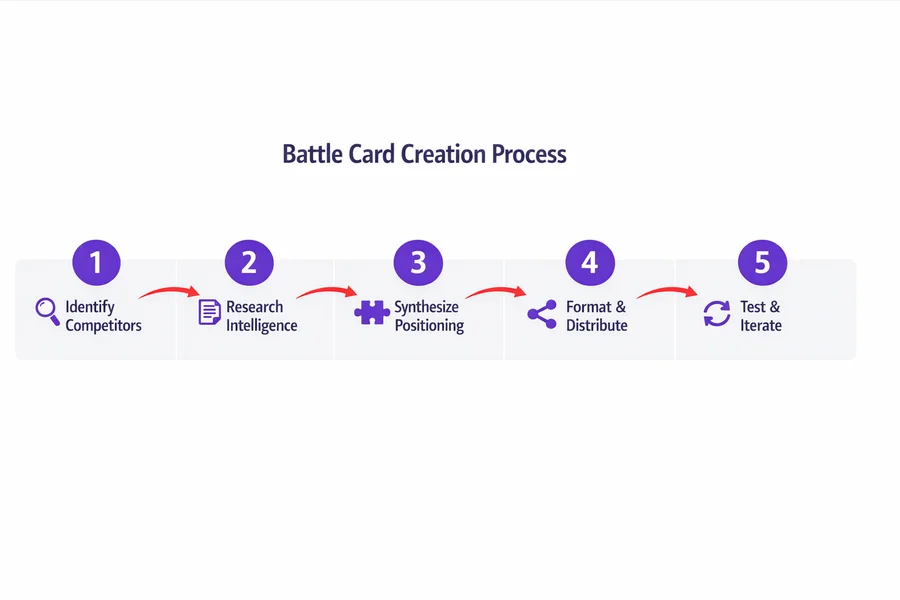
Step 1: Identify Your Top 3-5 Competitors
Don’t build battle cards for every company in your space. Focus on the competitors you actually lose deals to—or the ones that show up most frequently in competitive evaluations.
Start with your CRM data. Pull win/loss reports filtered by “competitive deal” and sort by competitor mention frequency. If your CRM doesn’t track competitors (fix that), ask your sales team: “Which three competitors come up most often in your deals?”
Our guide to identifying your direct and indirect competitors covers this step in depth. The key is to prioritize based on deal frequency, not market presence. A well-funded competitor you rarely encounter doesn’t need a battle card yet.
Step 2: Research Competitor Intelligence
This is the competitive intelligence work that separates great battle cards from generic ones. Here’s where to look:
- Competitor websites: Pricing pages, product pages, case studies, and “why us” messaging. Check their changelog or release notes for recent feature launches.
- G2 and Capterra reviews: Filter by one and two-star reviews to find recurring complaints—these become your competitive advantages. Filter by five-star reviews to understand genuine strengths.
- Job postings: A competitor hiring for “enterprise sales team” or “SOC 2 compliance manager” signals strategic direction.
- Social media and LinkedIn: Follow their executives. Product announcements, thought leadership posts, and employee comments reveal positioning and priorities.
- Press releases and funding announcements: These reveal strategic priorities and financial health.
- Product demos and free trials: If possible, sign up and use the product. Nothing beats firsthand experience for identifying genuine strengths and weaknesses.
- Your own sales team: Reps hear competitor messaging directly from prospects. Set up a Slack channel (#competitive-intel) where reps share what they’re hearing in real time.
For a deeper dive into gathering and using competitive intelligence, explore these competitive intelligence examples that show the process in action.
Organize your raw intelligence in a simple spreadsheet before moving to the next step. Don’t try to synthesize while you’re still gathering—you’ll miss things.
Step 3: Synthesize Into Positioning
Turn your raw intelligence into actionable positioning statements using this framework:
“They say X → The reality is Y → We’re better because Z”
For example:
- They say: “We’re the all-in-one platform for [category].”
- The reality: Their reporting module is basic and most customers still use a separate analytics tool.
- We’re better because: Our native analytics cover [specific capabilities], eliminating the need for a separate tool. [Customer name] reduced their reporting stack from three tools to one.
Write objection handlers the same way—grounded in reality, not marketing spin. A rep should be able to say these responses in a natural conversation without sounding scripted.
Building a competitive matrix alongside your battle cards helps you spot patterns across competitors and identify your true differentiators.
Step 4: Format and Distribute
Format for scanning, not reading. Use a consistent template (see our template below) with clear section headers, bold key phrases, and bullet points. Keep it to one page—two pages maximum for complex enterprise competitors.
Distribution is where most battle card programs fail. The best battle card in the world is useless if reps can’t find it. Put battle cards where your team already works:
- CRM: Embed as a resource on the competitor’s account or opportunity page in Salesforce or HubSpot.
- Slack: Pin to a #battlecards or #competitive-intel channel. Create a simple bookmark system for quick retrieval.
- Internal wiki: Notion, Confluence, or Google Docs with a consistent naming convention (e.g., “Battlecard: [Competitor Name]”) so they’re searchable.
- Dedicated CI platforms: Tools like Klue or Crayon centralize battle cards with usage analytics—but they’re a significant investment ($15K-$30K+/year). Most mid-market teams start with Slack + CRM and upgrade when usage justifies the spend.
The key: make battle cards findable by competitor name, not buried three folders deep in a shared drive.
Step 5: Test and Iterate
Don’t roll out battle cards to the entire team on day one. Start with two or three senior reps who regularly handle competitive deals.
Ask them to use the battle cards for two weeks and provide specific feedback:
- What sections did they actually reference during a call?
- What was missing that they needed?
- What felt outdated or inaccurate?
- Was the format easy to scan quickly?
Incorporate their feedback, then distribute to the full team. Track adoption: Are reps actually opening battle cards? Which sections do they reference most? Collect feedback monthly and treat battle cards as a living document, not a one-time project.
Battle cards are one of several sales enablement materials your team needs—and they work best when integrated into your broader enablement strategy.
Want more CI frameworks and templates? Subscribe to the Unkover newsletter for weekly competitive intelligence insights delivered to your inbox.
How to Keep Battle Cards Updated
The number one reason battle cards fail: they go stale. A battle card with last year’s competitor pricing or a deprecated product feature is worse than no battle card at all—it makes your reps look uninformed.
According to Crayon’s research, 44% of companies still lack competitor visibility in their CRM—a clear signal that keeping competitive content current remains a widespread challenge. Here’s how to stay ahead:
Set a refresh cadence. Monthly at minimum. Quarterly is too slow for fast-moving SaaS markets where competitors ship features and change pricing frequently. In slower-moving industries, quarterly reviews may suffice—but if you’re in SaaS, monthly is the floor.
Assign a single owner. One person—typically a product marketing manager or CI lead—owns each battle card. They’re responsible for the monthly review, even if they source updates from sales, product, and marketing. Shared ownership means no ownership.
Create trigger-based updates. Don’t wait for the monthly review if something significant happens. These events should trigger an immediate battle card update:
- Competitor launches a major new feature or product
- Competitor changes pricing or packaging
- New messaging appears on their website or sales collateral
- A pattern of new objections emerges from deal reviews
- A significant G2/Capterra review surfaces a previously unknown strength or weakness
- You win or lose a major deal against that competitor
Build a feedback loop with your sales team. Create a simple way for reps to flag “this battle card is wrong” or “I heard a new objection.” A Slack emoji reaction, a Google Form, or a dedicated #battlecard-feedback channel all work. The fastest path to stale battle cards is cutting reps out of the update process.
Battle Card Template
Here’s a complete battle card template you can copy directly into Google Docs, Notion, Confluence, or any other tool your team uses. Below the blank template, we’ve included a filled-in example using a fictional SaaS company so you can see what a completed battle card looks like.
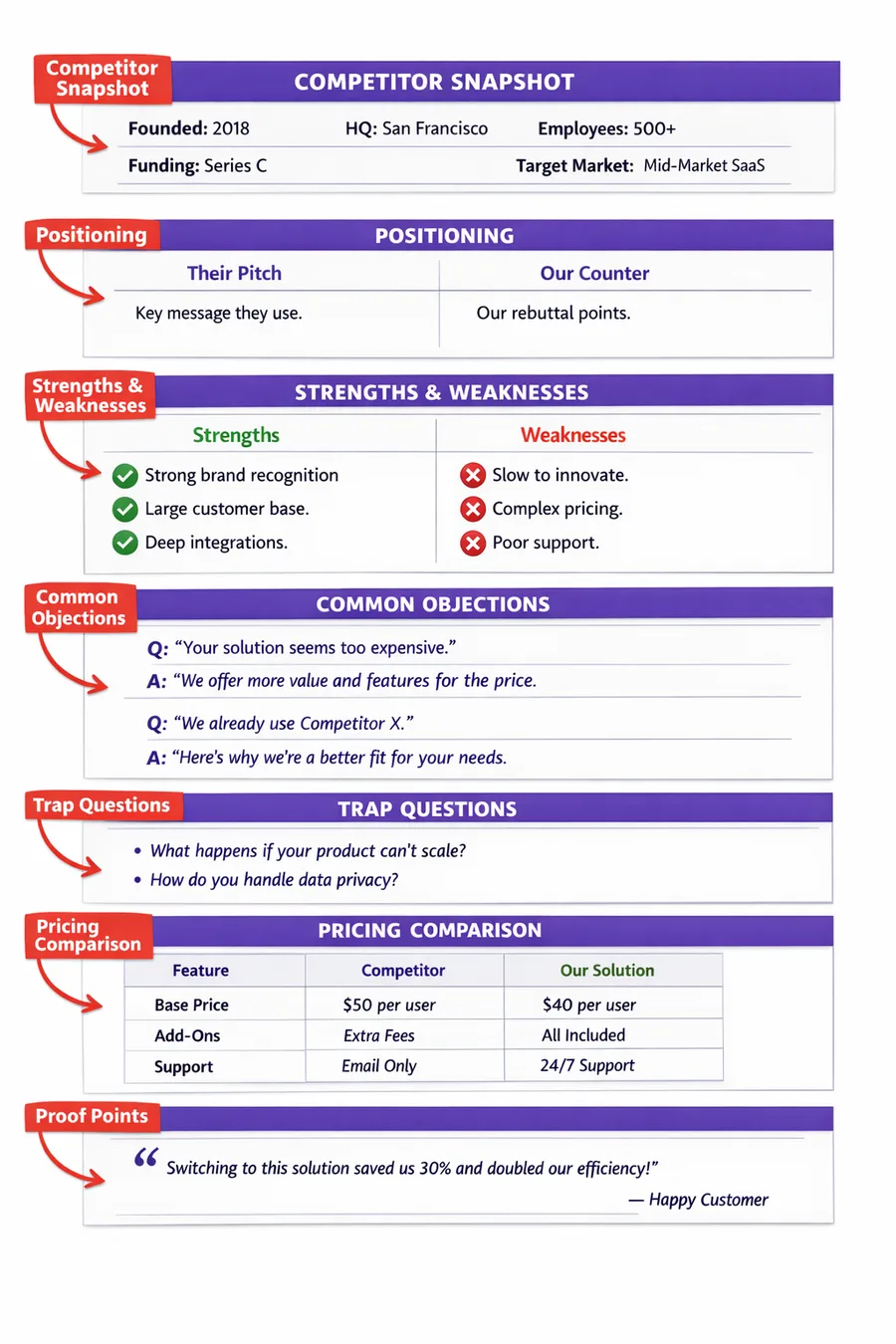
BATTLE CARD TEMPLATE
COMPETITOR: [Competitor Name]
Last updated: [Date] | Owner: [Name/Role]COMPETITOR SNAPSHOT
- Founded: [Year] | HQ: [Location]
- Employees: [Count] | Funding: [Amount/Stage]
- Target market: [Who they sell to]
- Positioning: [Their tagline or core value prop in their own words]
THEIR POSITIONING vs. OURS
Competitor Us Core message [How they position] [How we position] Target buyer [Who they target] [Who we target] Key differentiator [What they claim] [What we claim] STRENGTHS (be honest)
- [Genuine strength #1]
- [Genuine strength #2]
- [Genuine strength #3]
WEAKNESSES (backed by evidence)
- [Weakness #1] — Source: [G2 reviews / product testing / customer feedback]
- [Weakness #2] — Source: [evidence]
- [Weakness #3] — Source: [evidence]
TOP OBJECTIONS + RESPONSES
Objection Why it comes up Response Proof point “[Objection #1]” [Context] [Talk track] [Case study / data] “[Objection #2]” [Context] [Talk track] [Case study / data] “[Objection #3]” [Context] [Talk track] [Case study / data] TRAP-SETTING QUESTIONS
Ask the prospect these questions to surface competitor weaknesses:
- “[Question that exposes weakness #1]”
- “[Question that exposes weakness #2]”
- “[Question that exposes weakness #3]”
PRICING INTEL
- Their pricing model: [Per user/flat rate/usage-based]
- Typical deal size: [Range]
- Known discounting behavior: [Notes]
- How to position on price: [Guidance]
PROOF POINTS
- [Customer name]: [Result achieved]
- [Data point]: [Relevant statistic supporting your advantage]
Filled Example: Acme CRM vs. RivalCRM
BATTLE CARD: RivalCRM
COMPETITOR: RivalCRM
Last updated: March 2026 | Owner: Sarah Chen, Product MarketingCOMPETITOR SNAPSHOT
- Founded: 2019 | HQ: San Francisco, CA
- Employees: ~350 | Funding: $85M Series C
- Target market: Mid-market B2B SaaS (50–500 employees)
- Positioning: “The AI-powered CRM that sells for you”
THEIR POSITIONING vs. OURS
RivalCRM Acme CRM Core message AI automates the entire sales process AI assists reps—you stay in control Target buyer Sales teams wanting full automation Sales teams wanting AI-augmented selling Key differentiator Autonomous AI email sequencing Customizable workflows + native analytics STRENGTHS (be honest)
- Strong AI email generation—their sequencing product is genuinely best-in-class
- Fast onboarding—most teams are live in under a week
- Aggressive pricing on annual contracts ($45/user/mo vs. our $55/user/mo)
WEAKNESSES (backed by evidence)
- Reporting is basic—38% of G2 reviews mention needing a separate analytics tool (Source: G2, filtered Jan–Mar 2026)
- No native forecasting—they rely on a third-party integration that breaks frequently (Source: product testing, Feb 2026)
- Customer support rated 3.2/5 on G2—”slow response times” is the #1 complaint in negative reviews
TOP OBJECTIONS + RESPONSES
Objection Why it comes up Response Proof point “RivalCRM is cheaper” Their per-seat price is $10/mo lower “True on per-seat price—but factor in the separate analytics tool most teams need. Our customers report 15–20% lower total cost of ownership when you include the full stack.” DataFlow Inc. saved $18K/year by consolidating from RivalCRM + analytics tool to Acme CRM. “RivalCRM’s AI writes emails automatically” Their AI sequencing is impressive in demos “It does—and it’s strong for high-volume outbound. But autonomous AI emails hit diminishing returns fast. Our approach gives reps AI suggestions they can customize, which consistently produces 2x higher reply rates than fully automated sequences.” Acme customers average 12% reply rates vs. 6% industry average for fully automated sequences (internal benchmark, Q4 2025). “We need something faster to implement” RivalCRM demos well with quick setup “RivalCRM is fast to deploy—but fast setup doesn’t mean fast time-to-value. Our guided onboarding takes two weeks instead of one, but includes workflow customization that means reps are fully productive on day 15, not week 8.” TechNova went live in 14 days and hit full adoption in three weeks vs. two months with their previous CRM. TRAP-SETTING QUESTIONS
- “How are you currently handling sales forecasting? Is it built into your CRM or a separate tool?” (RivalCRM has no native forecasting)
- “What does your reporting workflow look like today? Can you build custom dashboards inside your CRM?” (Exposes their basic reporting)
- “When your team has a technical issue, what’s the typical resolution time with your current vendor?” (Surfaces their support weakness)
PRICING INTEL
- Their pricing model: Per user/month, annual contract required for best rate
- Typical deal size: $15K–$40K/year (mid-market)
- Known discounting: Aggressive on annual commits (up to 25% off), especially at quarter-end
- How to position on price: Lead with total cost of ownership (TCO), not per-seat price. Include the cost of supplementary tools they’ll need (analytics, forecasting).
PROOF POINTS
- DataFlow Inc.: Switched from RivalCRM—consolidated three tools into Acme CRM, saving $18K/year and reducing reporting time by 60%.
- TechNova: 14-day deployment to full adoption. Sales team hit 120% of quota in first full quarter on Acme CRM.
- Internal data: Acme CRM customers average 23% shorter sales cycles compared to industry benchmark (Q4 2025 analysis).
Key Takeaways
- Battle cards are your highest-leverage CI deliverable. 79% of CI professionals produce battle cards for good reason—they directly impact win rates in competitive deals.
- Focus on intelligence, not just formatting. The research process behind a battle card matters more than how it looks. Invest time in gathering genuine competitive intelligence from reviews, product testing, job postings, and your own sales team.
- Keep it to one page and make it scannable. Reps won’t use a three-page document. Bullets, bold text, and clear section headers are essential.
- Distribute where reps already work. The best battle card fails if it’s buried in a shared drive. Pin it in Slack, embed it in your CRM, make it searchable by competitor name.
- Set a monthly refresh cadence with a single owner. Stale content is the #1 killer of battle card programs. Assign ownership, create trigger-based updates, and build a feedback loop with your sales team.
Want to go deeper on competitive intelligence? Explore our competitive intelligence examples for more frameworks, methods, and real-world applications.
Subscribe to the Unkover newsletter for weekly competitive intelligence insights, templates, and frameworks delivered to your inbox.



![Effortless Competitive Battle Cards for Sales Leaders [7-Step Playbook]](https://unkover.com/wp-content/uploads/2024/04/unkover-illust-battlecards-300x158.webp)