

TL;DR: Most teams only track direct competitors — companies selling the same product to the same buyers. But three other competitor types can blindside you: indirect competitors (different product, same problem), replacement competitors (solutions that eliminate your category entirely), and potential competitors (companies poised to enter your market). This guide breaks down all four types with B2B/SaaS examples and gives you a practical framework for deciding who to track and how often. Updated for 2026 with a fifth category the original four miss: AI-native competitors, which sell your outcome without selling your product.
Your biggest competitive threat probably isn’t who you think it is.
The company stealing your customers right now might not even sell the same product. They might solve the same problem with a completely different approach, operate in an adjacent market, or offer a technology that makes your entire category irrelevant.
According to Crayon’s 2026 State of Competitive Intelligence report, 57.5% of teams say more of their deals are competitive than a year ago, and only 16% say the pressure eased. But when most teams say “competitor,” they mean the three or four companies in their G2 category with similar feature sets and pricing pages. That creates a massive blind spot.
Understanding the difference between direct vs indirect competitors is just the starting point. This guide covers all four types of competitors every business faces — direct, indirect, replacement, and potential — with B2B/SaaS examples that go beyond the tired Coke-vs-Pepsi comparisons, plus a practical framework for categorizing and monitoring each type.
What Are Direct Competitors?
Direct competitors sell essentially the same product or service to the same target customers. They compete for the same budget line item and typically appear side-by-side on comparison sites, analyst reports, and prospect shortlists.
These are the competitors you already know by name.
Key characteristics of direct competitors:
- Offer the same core features and capabilities
- Target the same buyer persona and use case
- Compete for the same budget allocation
- Show up in the same G2 or Capterra categories
- Appear in your win/loss data regularly
Direct Competitor Examples
B2B/SaaS: HubSpot and Salesforce are direct competitors in the CRM space. Both platforms target sales teams with contact management, pipeline tracking, and deal forecasting. A VP of Sales evaluating one will almost certainly evaluate the other — and the budget for either comes from the same line item.
B2B/SaaS: In the competitive intelligence (CI) space, Klue and Crayon are direct competitors. Both platforms help product marketing teams collect, organize, and distribute competitive intel. They target the same personas, solve the same problem, and compete head-to-head in nearly every deal.
Outside SaaS, the textbook example is Nike and Adidas in athletic footwear — same product, same customer, same shelf.
Common Mistake: Not Every Company in Your G2 Category Is a Direct Competitor
Product marketers often equate “same category” with “direct competitor.” That’s a trap. A G2 category might list 50+ companies, but only three to five are genuinely direct competitors — the ones your sales team encounters in actual deals. The rest might be indirect competitors targeting a different segment, or niche tools solving a related but different problem.
Check your win/loss data before your G2 listing. The competitors your prospects actually evaluate are your direct competitors. Everything else needs a different label.
What to Monitor for Direct Competitors
- Pricing changes — adjustments signal a strategic shift
- Feature launches — new capabilities that change competitive positioning
- Messaging and positioning shifts — how they talk about themselves on their homepage, ads, and sales decks
- Customer reviews on G2, Capterra, and TrustRadius — unfiltered buyer sentiment
- Hiring patterns — job postings reveal product roadmap priorities
Track direct competitors weekly. These are the rivals that show up in your deals, and falling behind on intel here costs revenue. One way to activate this intel is to arm your sales team with competitive battle cards that address objections and highlight differentiation in real time. For real-world examples of how teams turn competitor tracking into action, see our roundup of competitive intelligence examples in action.
What Are Indirect Competitors?
Indirect competitors solve the same customer problem you do, but with a different product or approach. They’re fighting for the same outcome — and often the same budget conversation — but the solution looks nothing like yours.
This is where the “direct vs indirect competitors” distinction gets strategically important. Direct competitors are obvious. Indirect competitors are the ones that blindside you.
The “Same Job, Different Solution” Test
Clayton Christensen’s Jobs to Be Done (JTBD) framework is the best lens for spotting indirect competitors. The concept is straightforward: customers don’t buy products — they “hire” products to get a job done.
When you think about competition through this lens, your competitive landscape expands dramatically. Every product or service that gets the same job done — regardless of category — is an indirect competitor.
Indirect Competitor Examples
B2B/SaaS: Notion and Monday.com are indirect competitors. Both solve the “coordinate work across teams” problem, but Notion is a docs-first workspace while Monday.com is a workflow-first project management tool. A team evaluating Notion might never look at Monday.com in a feature comparison — but they’re solving the same coordination job.
B2B/SaaS: A competitive intelligence platform like Klue and a consulting firm delivering quarterly competitive reports. Both deliver competitive intelligence. One is software-driven and continuous; the other is human-driven and periodic. Same job. Radically different approach. The buyer might weigh both options, but the budget could come from entirely different line items.
The consumer equivalent: Uber and public transit. Both solve the “get from A to B” job through completely different products, pricing models, and experiences.
Why Indirect Competitors Are Often More Dangerous Than Direct Ones
Direct competitors play by the same rules you do. You understand their playbook because it mirrors yours. Indirect competitors rewrite the rules entirely.
Three reasons they’re dangerous:
- They redefine the evaluation criteria. When a prospect compares your CI platform to a consulting firm’s quarterly report, “features” stop mattering. The conversation shifts to “depth of analysis” vs. “speed and scalability.”
- They expand from unexpected angles. Indirect competitors often have a larger user base or broader product surface area. When they add features that overlap with your core value proposition, they bring their entire install base with them. Zoom is a case in point: it started as a video conferencing tool — a distant indirect competitor to messaging platforms. When it launched Zoom Team Chat in 2022, it became a direct challenger to Slack and Microsoft Teams, bringing its 300M+ daily meeting participants along for the ride.
- They’re easy to dismiss — until they’re not. Teams that only monitor direct competitors miss the indirect players quietly eating market share with a fundamentally different approach.
How to Identify Indirect Competitors
- Run a Jobs to Be Done analysis: Ask your customers, “If our product didn’t exist, what would you use instead?” The answers will surprise you.
- Analyze lost deals: Look at prospects who went silent or chose “no decision.” They may have solved the problem with a completely different type of solution.
- Map budget allocation: Find out what other tools or services compete for the same budget bucket. If a CFO sees your software and a consultant’s engagement as interchangeable spending, they’re indirect competitors.
What to Monitor for Indirect Competitors
- Product expansion moves (new features encroaching on your territory)
- Funding rounds and acquisitions (signals of growth ambition)
- Positioning changes (shifting messaging toward your value prop)
- Customer overlap (shared logos appearing on their case study page)
Track your top two to three indirect competitors monthly.
Direct vs Indirect Competitors: Key Differences
The difference between direct and indirect competitors comes down to what they sell versus what problem they solve.
| Factor | Direct Competitor | Indirect Competitor |
|---|---|---|
| Product | Same or very similar | Different product, same outcome |
| Target customer | Same buyer persona | Same or adjacent buyer |
| Budget | Same budget line item | May come from a different budget |
| How you find them | Win/loss data, G2 categories | JTBD analysis, customer interviews |
| Threat type | Obvious and measurable | Hidden and often underestimated |
| Example | Klue vs. Crayon | CI platform vs. McKinsey report |
| Monitoring cadence | Weekly | Monthly |
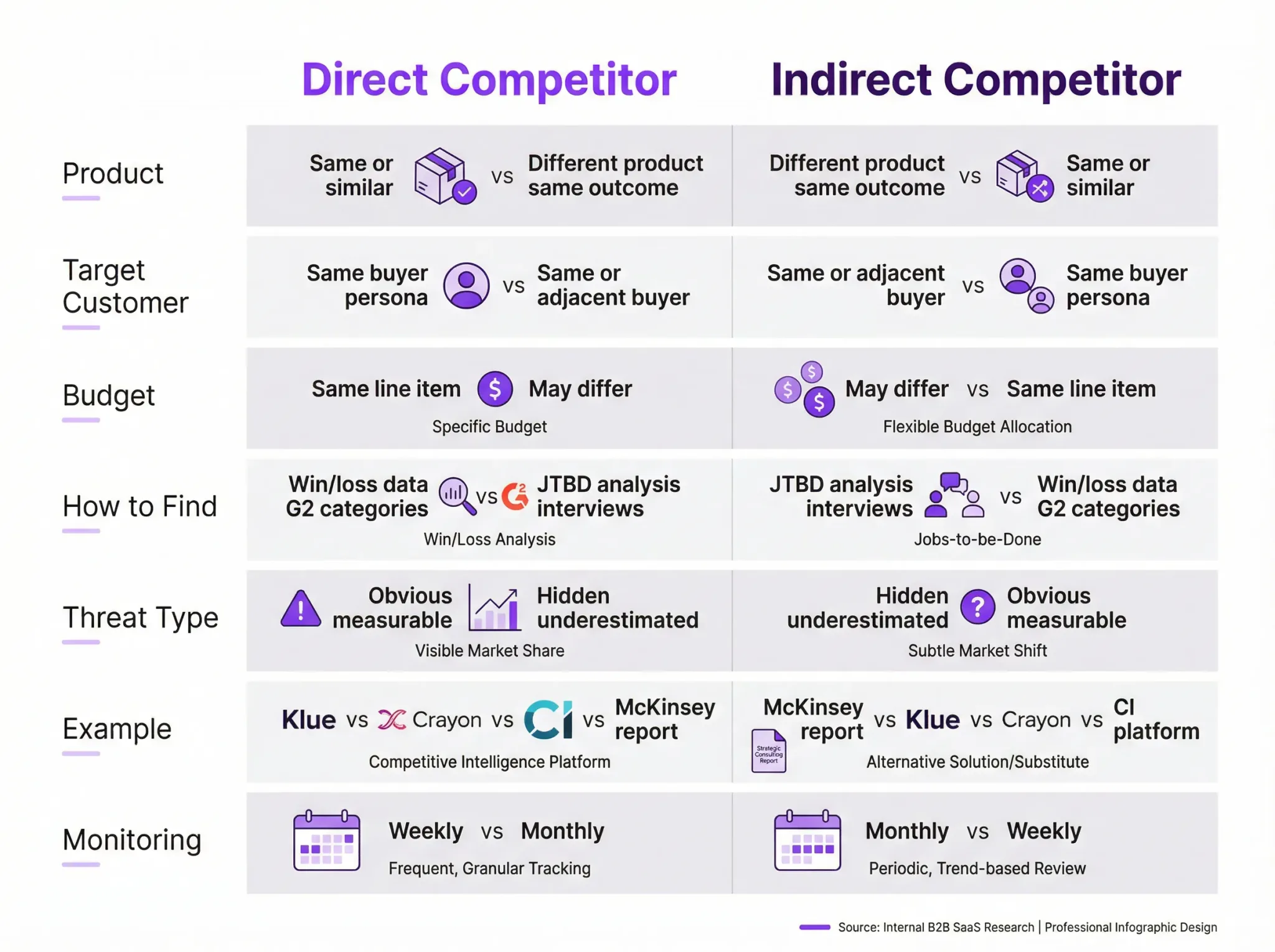
The “Budget Conversation Test” is the simplest way to classify a competitor: If a prospect is choosing between you and them with the same budget, they’re direct. If they solve the problem differently and your solution wasn’t even in the running, they’re indirect.
One caveat for enterprise deals: the same problem can have budget spread across multiple departments. An indirect competitor might be funded by a budget line your sales team never sees — making them invisible in your pipeline data. The Budget Conversation Test still works, but you need to look beyond the single buyer to map the full budget landscape.
What Are Replacement (Substitute) Competitors?
Replacement competitors are products, technologies, or behaviors that could eliminate the need for your entire product category. They don’t just compete with you — they make what you sell obsolete for a segment of the market.
Michael Porter identified the threat of substitutes as one of the five forces shaping industry competition. The concept is straightforward: when a substitute offers a better price-performance trade-off, customers switch — and they don’t move to a competitor. They leave your category entirely.
Replacement Competitor Examples
B2B/SaaS: ChatGPT disrupting dedicated AI writing tools. When OpenAI launched ChatGPT, specialized content writing tools like Jasper and Copy.ai — which had raised hundreds of millions in funding — suddenly faced a general-purpose AI that could do 80% of what they did at a fraction of the cost. The competitive threat didn’t come from within their category. It came from a technology shift that redefined the category itself.
B2B/SaaS: In-house engineering teams replacing no-code platforms. At the early stage, companies adopt no-code tools like Bubble or Webflow to build fast. As they grow and hire engineers, they often migrate to custom-built solutions — not because a competitor was better, but because the category no longer fit their needs.
The most-cited example in business history: streaming services replacing DVD rental. Netflix didn’t beat Blockbuster by opening better stores — it replaced the entire concept of physical media rental with a fundamentally different delivery model.
Why Replacement Competitors Matter
Indirect competitors are the most commonly overlooked competitor type. But replacement competitors are the most dangerous when they arrive. The former steals deals you knew about. The latter eliminates deals you assumed would always exist.
Replacement competitors reshape entire categories. By the time you notice the shift, it’s often too late to adapt. Most CI programs focus overwhelmingly on the direct competitors teams already know, while the technologies and business models reshaping their categories go untracked until the shift is impossible to ignore.
The pattern is consistent: established companies lose market share not to better versions of their own product, but to fundamentally different approaches that buyers adopt as substitutes. The AI writing tools that lost ground to ChatGPT didn’t see a competitor come along with better templates or more features. They saw an entirely new category of technology absorb their use case.
How to Identify Replacement Competitors
- Analyze technology trends: What emerging capabilities could make your product unnecessary for some customers?
- Study churn destinations: The most reliable signal for replacement threats isn’t market scanning — it’s churn analysis. When customers leave and they don’t go to a direct competitor, they’re either moving to a replacement solution or reverting to non-consumption. Both signal that your category is under pressure.
- Monitor “non-consumption”: Sometimes the biggest replacement threat is customers deciding they don’t need a solution at all — they build an internal workaround or accept the status quo.
Track replacement threats quarterly. You won’t see changes week to week, but missing a technology shift for six months can be fatal.
What Are Potential (Emerging) Competitors?
Potential competitors are companies not currently competing in your market but positioned to enter. They have the resources, technology, customer base, or market adjacency to become a competitor — they just haven’t made the move yet.
These are the competitors that don’t show up in any G2 comparison or win/loss report. They show up in your market with a press release and an overnight install base.
Potential Competitor Examples
B2B/SaaS: A CRM platform adding competitive intelligence features. Imagine Salesforce building a native CI module that lets sales teams access battlecards, track competitor mentions, and analyze win/loss data — all without leaving their CRM. Standalone CI tools like Klue and Crayon would face a new competitor overnight, one that already has 150,000+ enterprise customers.
B2B/SaaS: An adjacent SaaS company entering your space through acquisition. When a large platform buys a smaller player in your market, they instantly become a competitor backed by significantly more resources and distribution power.
In the consumer world, think Apple entering automotive. Apple has the technology, capital, supply chain expertise, and brand — but it hasn’t shipped a car yet. The day it does, the competitive landscape changes overnight.
Warning Signs That a Potential Competitor Is About to Enter Your Market
- Job postings in your domain. A CRM company hiring competitive intelligence analysts? That’s a signal.
- Strategic acquisitions. When a larger company acquires a small player in your space, they’re buying a beachhead.
- Product features creeping toward your territory. A platform adding capabilities that overlap with your core product, one feature at a time.
- Executive statements about expansion. Earnings calls, investor presentations, and conference keynotes where leaders mention your market as a growth area.
- Patent filings. New intellectual property in your domain from companies outside it.
A related concept worth tracking: perceived competitors are companies your buyers view as alternatives based on brand positioning or market association, even when products don’t directly overlap. A lightweight project tracker, for instance, might be compared to Jira in buyer evaluations — not because they’re interchangeable, but because the buyer perceives them as options for the same need. Understanding perceived competitors alongside potential ones ensures you see both how buyers frame their choices and where genuine market-entry threats are forming.
Track potential competitors semi-annually. Keep a short watchlist of two to three companies with the adjacency and resources to enter, and revisit it twice a year.
What About AI-Native Competitors? The Fifth Type of Competitor to Track
AI-native competitors are products built around a model rather than around a seat. They sell the same outcome you sell, to the same buyer, but they package it as work performed instead of software licensed. The price is per task, per agent, or per result. They belong to your category and break its pricing logic at the same time.
The four-type framework has no box for them, so most competitive reviews don’t have one either.
Why AI-Native Competitors Don’t Fit the Other Four Types
Run an AI-native entrant through the tests earlier in this guide and each one gives you the wrong answer.
- They’re not replacement competitors. A replacement competitor kills the job or the category — streaming ended DVD rental. An AI-native competitor keeps the job, keeps the category, and changes what a unit of value costs. Your buyer still needs the outcome. They stop needing 40 seats to get it.
- They’re not potential competitors. A potential competitor sits on a watchlist because it hasn’t moved. AI-native entrants are already selling, and they usually price below the threshold that triggers a procurement review, so they land inside your accounts without ever appearing in a competitive deal.
- They’re not indirect competitors. Indirect competitors solve the problem differently enough that they rarely make your shortlist. AI-native entrants make the shortlist, then reframe the evaluation from feature parity to cost per outcome — a comparison your pricing page isn’t built to win.
Gartner puts numbers on it. In forecasts cited in Deloitte’s 2026 technology predictions, 35% of point-product SaaS tools will be replaced by AI agents or absorbed into larger agent ecosystems by 2030, and at least 40% of enterprise SaaS spend will move toward usage-, agent-, or outcome-based pricing over the same period. Deloitte adds the budget side: in its 2025 Tech Value survey, 20% of respondents were already putting half or more of their digital transformation budget into AI automation, and Deloitte predicts that up to half of organizations will cross that line in 2026.
AI-Native Competitor Examples
B2B/SaaS: In competitive intelligence itself, a product marketer running a research agent against a competitor’s pricing page, changelog, and job board gets a usable brief in an afternoon. That work used to justify a platform subscription. The agent doesn’t replace a CI platform for a mature program, but it absorbs the low end of the market — the part of the funnel where a lot of new logos start.
B2B/SaaS: Customer support tooling. Incumbent helpdesks bill per agent seat. AI-native entrants bill per resolved ticket. When a support leader’s headcount plan shrinks because deflection went up, the seat-based vendor loses revenue without ever losing a head-to-head evaluation.
The pattern in both cases: you don’t lose the deal. You lose the seats.
Warning Signs an AI-Native Competitor Is Taking Your Market
- Their pricing page has no seat count. Pricing by outcome instead of by user is a positioning statement aimed at your renewal.
- Your renewals shrink while your logo retention holds. Customers stay and buy less. That’s the signature of outcome pricing eating seat pricing, and it doesn’t show up in win/loss data.
- Buyers ask whether your product has an API or agent surface before they ask about features. The question means they intend to compose their stack, not buy it whole.
- Your champions start building internally. When a customer’s ops team ships an internal workflow that covers half of what you sell them, the replacement threat is coming from inside the account.
What to Monitor for AI-Native Competitors
- Pricing model changes, not price changes — the shift from seats to usage matters more than the number
- Launch of agent or API surfaces on adjacent products, including Model Context Protocol (MCP) servers
- Funding rounds for companies describing themselves as AI-native in your category
- Your own net revenue retention split by seat expansion versus usage expansion
Track AI-native entrants monthly, on the same cadence as indirect competitors. They move faster than replacement threats and slower than the panic in your feed suggests: Deloitte is explicit that wholesale application replacement “won’t be in 2026” and will take at least five years. The likelier failure is quieter: two more years of benchmarking against the wrong set of companies.
If you want the other side of this — using the same technology on your own competitive program rather than defending against it — see our guide to AI competitive intelligence.
How to Identify Your Competitors (A Practical Framework)
We covered identification tactics specific to each competitor type above. The following framework combines them into a single, systematic process your team can run quarterly — moving from known competitors outward into increasingly uncertain territory.
Steps 1 through 4 map the four classic categories. Step 5 catches the entrants that don’t sit on any of those rings.
Step 1: Map Your Direct Competitors
Start with what you know. Pull data from:
- Win/loss reports: Which companies appeared in deals you won or lost?
- G2 and Capterra categories: Who’s listed alongside you?
- Prospect shortlists: Which tools do buyers mention during sales calls?
- Sales team input: Reps know who they compete against in the field.
Aim for three to five direct competitors. If you have more than five, you may be conflating direct with indirect.
Step 2: Identify Indirect Competitors
Use the JTBD framework:
- Ask customers: “If our product disappeared tomorrow, how would you solve this problem?”
- Analyze lost deals where “no decision” won: These prospects found another way to get the job done.
- Map budget conversations: What other tools or services compete for the same spend?
Target two to three indirect competitors to track actively.
Step 3: Scan for Replacement Threats
Focus on where customers go when they leave:
- What emerging trend could make your category unnecessary? (AI disrupting content tools, automation replacing manual services)
- Where are churning customers going? If they’re not going to a competitor, they’re going to a substitute. Run a churn destination analysis quarterly — the pattern of where departing customers land tells you which competitor type is actually hurting your business.
- What’s happening in adjacent technology categories that could cross into your space?
Watch one to two replacement threats.
Step 4: Build a Potential Entrant Watchlist
Look at adjacency:
- Who has the customers you want and the resources to build what you sell?
- Who is making acquisitions in or near your space?
- Who is hiring for roles that overlap with your product domain?
Track one to two potential entrants.
Step 5: Check for AI-Native Entrants
Look at your pricing model, not your feature list:
- Who in your category charges for outcomes instead of access? Search your market’s newest entrants and read their pricing pages before their homepages.
- Where is your own revenue expanding? If net revenue retention is flat while logo retention is strong, something is capping seat growth. Find out what.
- What are your customers automating internally? Ask in QBRs. The workflows they build themselves are the roadmap of whoever productizes them next.
Track one to two AI-native entrants. If you’re running this across five categories with a spreadsheet, you’ll stop after two quarters — this is the point where competitive intelligence tools earn their cost, because the monitoring is continuous and the categories now overlap.
The Competitor Threat Matrix
Five categories with five cadences is hard to hold in your head. Two axes make it easier. Plot every competitor on: category proximity (how close their product sits to yours) and threat horizon (how soon they can cost you revenue).
| Near-term threat | Long-term threat | |
|---|---|---|
| Close to your category | Direct — same product, same buyer. Weekly. | Potential — adjacent players with the resources to enter. Semi-annually. |
| Far from your category | AI-native — same outcome, different unit of value. Monthly. | Replacement — technology shifts that dissolve the category. Quarterly. |
Indirect competitors are the diagonal: mid-proximity, mid-horizon, monthly. If a competitor is hard to place on this grid, that’s the useful signal: it usually means they’re moving between quadrants, which is exactly when they’re most dangerous.
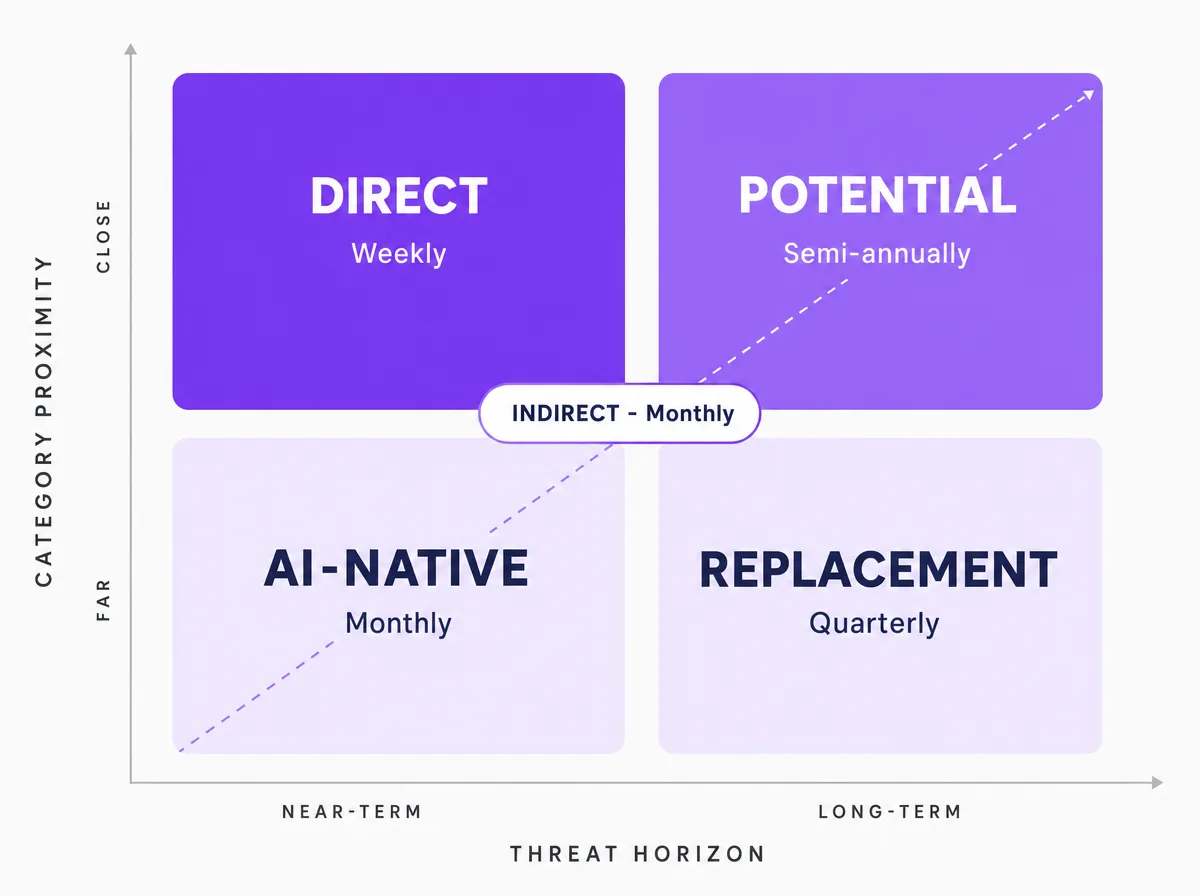
Pair this with our competitive analysis framework if you need the full workflow around it, and drop the results into a competitor analysis template so the categorization survives contact with your next planning cycle.
The Concentric Circles Model
Think of your competitive landscape as four concentric rings:
- Inner ring — Direct competitors: Monitor weekly. Deep tracking of pricing, features, reviews, hiring, and messaging.
- Second ring — Indirect competitors: Monitor monthly. Track product expansion, positioning changes, and funding.
- Third ring — Replacement threats: Monitor quarterly. Follow technology trends, adoption curves, and category shifts.
- Outer ring — Potential entrants: Monitor semi-annually. Watch job postings, M&A activity, and product roadmap signals.
- Cutting across all four — AI-native entrants: Monitor monthly. They don’t sit on a ring, because they can appear at any distance from your category and still compete for the same budget.
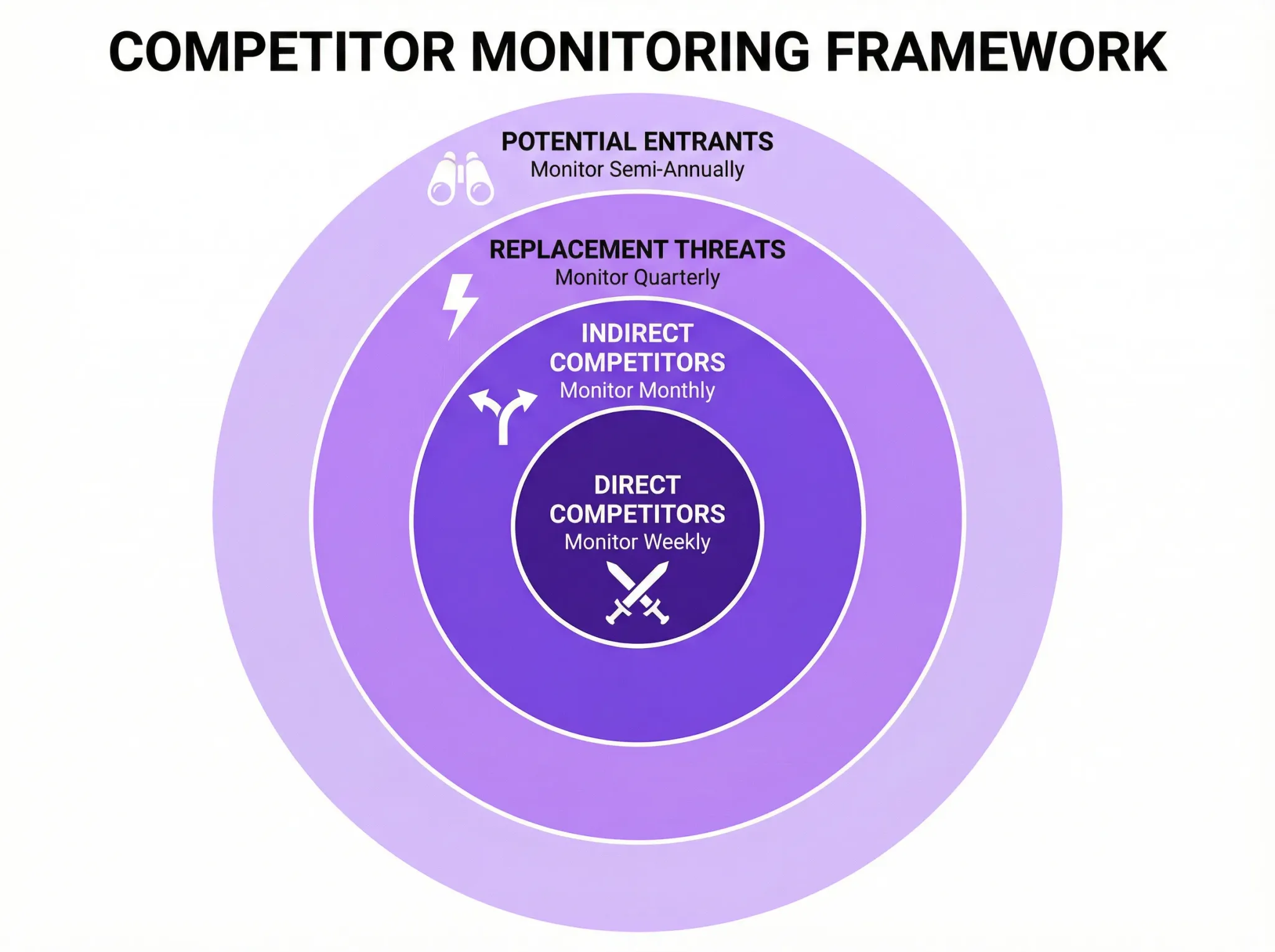
This model keeps your competitive intelligence program focused. You’re not tracking 50 companies — you’re tracking 9-14 with clear priorities and cadences.
Once you’ve identified and categorized your competitors, the next step is arming your sales team. See our guide to building competitive battle cards to turn intel into sales ammunition.
For a deeper dive into structuring your CI program end to end, see our complete guide to building a competitive intelligence program.
When Indirect Competitors Become Direct Threats
One dynamic most competitive frameworks overlook: the line between indirect and direct competition isn’t fixed. It shifts — and when it does, the results can be dramatic.
We call this “Feature Creep Convergence” — when two products add features toward each other until their capabilities overlap enough that they compete head-to-head.
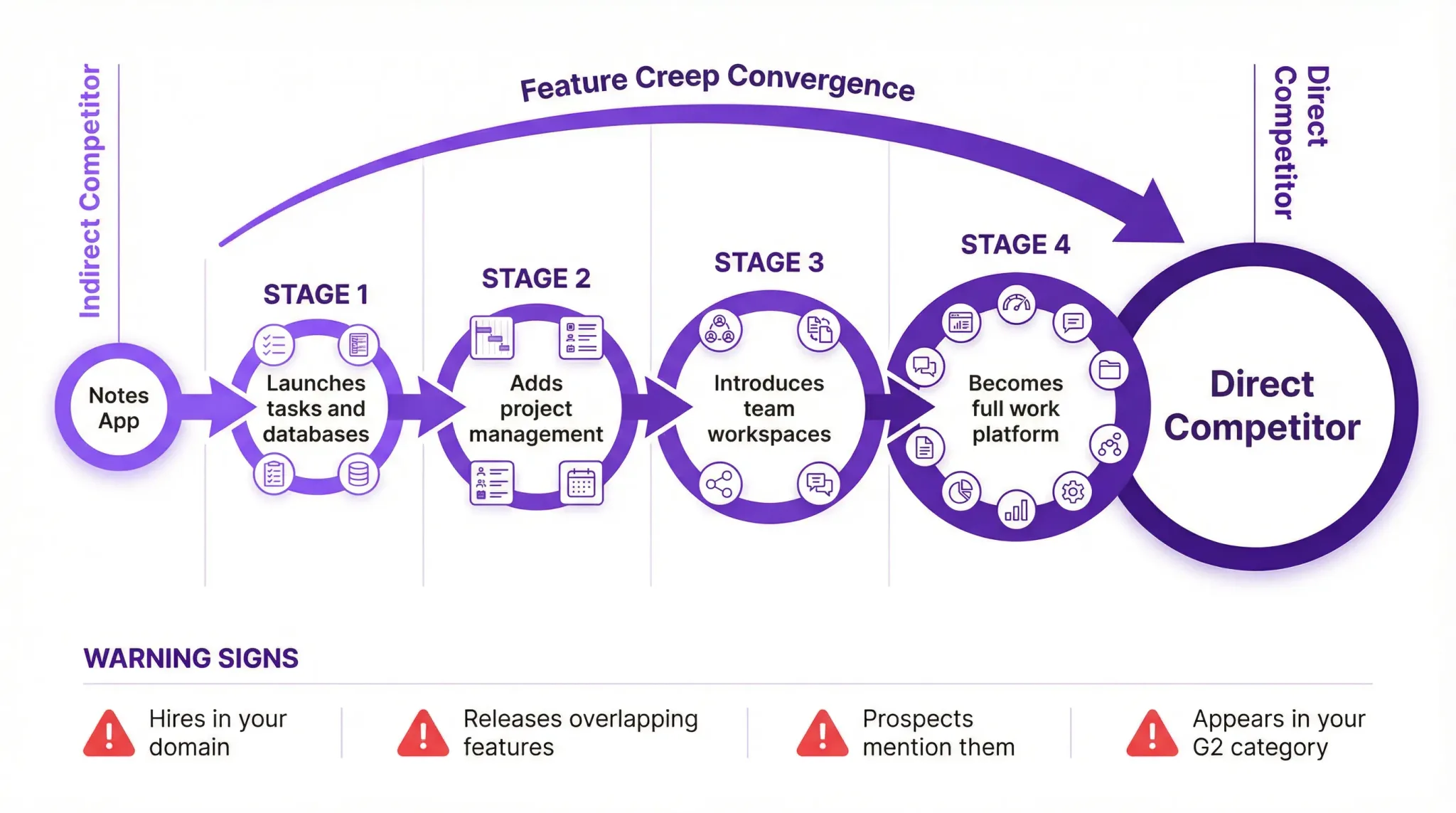
Case Study: Slack’s Expansion into Project Management
Slack started as a messaging tool. For years, it was an indirect competitor to project management platforms like Asana and Monday.com — both solved “team coordination,” but through fundamentally different approaches.
Then Slack launched Lists in 2025, a native task and project tracking feature. Combined with Canvases (long-form docs) and Workflow Builder — whose usage grew 34% in 2025, with 40% of paid teams using it weekly — Slack now offers project management capabilities embedded in the messaging tool teams already use daily. An indirect competitor quietly became a direct one.
Case Study: Notion’s Category-Defying Expansion
Notion launched as a note-taking and docs tool. In 2019, it had 1 million users. By 2025, it had crossed 100 million users and over $500 million in annual revenue, with over 4 million paying customers — and Notion didn’t get there by staying in the “notes” category.
Notion systematically expanded into project management (databases, Kanban boards, timelines), knowledge management (wikis, team spaces), and even CRM-like workflows. Today, Notion is a direct competitor to Jira, Confluence, Asana, Monday.com, and dozens of other tools — none of which considered a notes app a competitive threat in 2019.
When Your Distribution Channel Becomes Your Competitor
Feature Creep Convergence is particularly dangerous in platform businesses. Consider what happens when a search engine launches its own booking feature, letting users complete transactions directly from search results. The platform you depend on for customer acquisition — the one sending you traffic — suddenly competes for the same transaction. You can’t simply “monitor” a competitor that controls your distribution. You have to fundamentally rethink your acquisition strategy.
This is the most extreme form of indirect-to-direct conversion: the company you depend on becoming the company you compete against.
Four Warning Signs an Indirect Competitor Is Going Direct
- They hire in your domain. If a messaging company starts hiring project managers and product marketers with PM-tool experience, they’re building in your space.
- They launch features that overlap with your core value prop. One feature is a nice-to-have. Three features is a strategy.
- Prospects start mentioning them in sales calls. When buyers bring up an indirect competitor alongside your direct ones, the shift is already underway.
- They appear in your G2 category. By this point, the transition is complete — they’re now a direct competitor.
This is why your competitor categorization shouldn’t be a one-time exercise. Reassess your competitor categories quarterly. The indirect competitors you dismiss today may be the direct threats capturing your market share tomorrow.
How Many Competitors Should You Track?
The honest answer: fewer than you think.
Tracking 20+ competitors sounds thorough. In practice, it dilutes focus and produces intel that nobody acts on. Crayon’s 2026 research shows that teams sharing competitive intelligence weekly or faster achieve revenue impact at 79%, against 41% for teams that share monthly or slower — but that only works if the intel is focused and actionable. Spreading your attention across too many competitors guarantees the opposite.
What works for most mid-market teams:
| Competitor Type | How Many to Track | Monitoring Cadence | What to Watch |
|---|---|---|---|
| Direct | 3-5 | Weekly | Pricing, features, reviews, messaging, hiring |
| Indirect | 2-3 | Monthly | Product expansion, positioning, funding |
| Replacement | 1-2 | Quarterly | Technology trends, adoption curves, category shifts |
| Potential | 1-2 | Semi-annually | M&A activity, job postings, product adjacency |
| AI-native | 1-2 | Monthly | Pricing model shifts, agent/API surfaces, your own seat expansion |
That’s 8-14 competitors total. Enough to cover your landscape without overwhelming your team. Crayon’s 2026 data says nearly eight in ten teams track 30 competitors or fewer, so a tight list is the norm, not a shortcut.
The key is matching your monitoring depth to the threat level. Go deep on direct competitors — build battle cards, track every pricing change, read every G2 review. Package the intel into sales enablement materials your team can actually use in calls. Go broad on replacement and potential competitors — you’re looking for signals, not details.
For more frameworks on organizing your competitive landscape visually, see our guide on building a competitive matrix to map how each competitor type stacks up across key dimensions.
Key Takeaways
- Direct competitors sell the same product to the same buyers. You know who they are — track them weekly.
- Indirect competitors solve the same problem with a different approach. Use the Jobs to Be Done framework to find them — track your top two to three monthly.
- Replacement competitors threaten to make your category obsolete. Monitor technology shifts quarterly.
- Potential competitors aren’t in your market yet but have the resources and adjacency to enter. Watch for signals semi-annually.
- AI-native competitors sell your outcome without selling your product, and they compete on unit of value rather than features. Track one to two monthly — they show up in your renewal numbers before they show up in your win/loss data.
- The biggest mistake most teams make is only tracking direct competitors. The companies most likely to disrupt your market are the ones you’re not watching.
Want to build a systematic approach to tracking all four competitor types? Start with our complete guide: Competitive Intelligence — What It Is and How to Do It.
Frequently Asked Questions
What is the difference between direct and indirect competitors?
Direct competitors sell the same or very similar products to the same target customers — think HubSpot vs. Salesforce in CRM. Indirect competitors solve the same customer problem but with a different product or approach — like a CI software platform vs. a consulting firm’s quarterly competitive report. The simplest test: if a prospect chooses between you on the same budget, they’re direct. If they solve the problem without considering your product, they’re indirect.
What are the 4 types of competitors?
The four types are: (1) direct competitors — same product, same customer; (2) indirect competitors — different product, same problem; (3) replacement (substitute) competitors — solutions that could eliminate your category entirely; and (4) potential (emerging) competitors — companies not yet in your market but capable of entering. Most businesses only track the first two, which creates dangerous blind spots.
What is an example of a direct and indirect competitor?
Direct: Klue and Crayon are direct competitors — both are competitive intelligence platforms targeting product marketing teams with similar features. Indirect: A CI platform and a consulting firm delivering quarterly competitor reports are indirect competitors. Both deliver competitive intelligence, but through fundamentally different products and business models. The key distinction is whether the solution is the same (direct) or just the outcome (indirect).
How do you identify direct and indirect competitors?
For direct competitors, check your win/loss data, G2 category listings, and prospect shortlists — these are the companies that show up in actual deals. For indirect competitors, use the Jobs to Be Done framework: ask customers “If our product disappeared, how would you solve this problem?” and analyze deals lost to “no decision.” Also map what other tools or services compete for the same budget.
What is a replacement competitor?
A replacement competitor is a product, technology, or behavior that could eliminate the need for your entire product category. Unlike direct or indirect competitors that compete within or adjacent to your market, replacement competitors change the game entirely. Example: ChatGPT disrupting specialized AI writing tools — the threat didn’t come from within the content tool category but from a general-purpose AI that redefined it.
What is a perceived competitor?
A perceived competitor is a company that your customers or prospects view as a competitor, even if the products or markets don’t directly overlap. Perception is driven by brand positioning, marketing messaging, or category association rather than actual feature parity. For example, a prospect might compare a lightweight project tracking tool to enterprise platforms like Jira — not because they’re truly interchangeable, but because the buyer perceives them as options for the same need. Tracking perceived competitors helps you understand how buyers frame their choices, even when the competitive overlap is more psychological than functional.
Are AI tools a new type of competitor?
Yes — AI-native products are best treated as a fifth type of competitor rather than folded into the existing four. They sell the same outcome to the same buyer but price it by usage or outcome instead of by seat, so they compete for your budget without competing on your feature list. Gartner projects 35% of point-product SaaS tools will be replaced by AI agents or absorbed into agent ecosystems by 2030. Track them monthly, and watch pricing models rather than feature releases.
What are aspirational competitors?
Aspirational competitors are the companies you benchmark against but don’t yet compete with — the category leader whose positioning and pricing power you want to earn. They’re a planning device, not a threat category: useful for setting standards in messaging and product ambition, but they don’t belong in your monitoring cadence unless they’re also a direct, indirect, or potential competitor. Don’t spend CI hours on a company that isn’t in your deals.
Why is it important to know your direct and indirect competitors?
Because the company most likely to take your market share may not be in your G2 category. Only tracking direct competitors creates dangerous blind spots. Indirect competitors redefine evaluation criteria, expand from unexpected angles, and are easy to dismiss until they’ve already captured your customers. According to Crayon’s 2026 research, seven in ten teams say at least half of their sales opportunities are now competitive, while average rep readiness sits at 6.3 out of 10 — and many of the competitors behind that gap are indirect ones teams never saw coming. A complete competitive view covering all four types helps you anticipate threats instead of reacting to them.
We publish a new competitor tracking framework every week — from battle cards to win/loss playbooks. Subscribe to the Unkover newsletter to get them in your inbox.




One response to “Direct vs Indirect Competitors: The 4 Types You Need to Track”
Great post! It really made me realize how important it is to keep track of our competitors. I especially found the ‘Missing Links’ type of competitor to be fascinating. It’s really hard to know what we’re up against if we’re not aware of the competitors who are somehow linked to us. Thanks for sharing this valuable insight!