
A colleague drops a competitor’s pricing page into Slack: “They’ve moved upmarket.” You open it and find an enterprise plan, a contact-sales button, and no record of what the page said before. You have a useful lead. You don’t yet have evidence of a change.
Learning how to gather competitive intelligence starts with keeping that distinction intact. Save what you found, record what it supports, and decide when someone will check it again. Otherwise, a plausible interpretation can become a sales talking point before anyone verifies it.
The workflow below gives a part-time competitive intelligence (CI) owner a weekly routine and a completed source register to copy. We filled the example from Linear’s public pages on September 7, 2026. The observations are real; the internal team, buying question, and proposed actions are illustrative.
What should you collect this week?
Collect evidence that can answer a question someone on your team needs resolved. Start with one decision, a named reader, and a small competitor set. Give each source a specific job: pricing establishes the public offer, documentation explains a feature, and buyer conversations test whether that feature matters in actual evaluations.
For this example, the question is: “Can a buyer who requires SAML use Linear’s Business plan, or must they ask about Enterprise?” A product marketer might need the answer before updating a comparison page. A sales engineer might need it before a procurement call.
That question is narrow enough to settle with public evidence. “Is Linear moving upmarket?” would require a historical baseline and evidence of commercial behavior. “Are we losing deals because of SAML?” needs our own deal records and buyer input. Keep those questions separate.
Choose competitors from recent evaluations and customer conversations. If that list isn’t settled, use our guide to types of competitors before creating monitors. For a first cycle, three competitors is a reasonable operating limit, not an industry benchmark.
Write four things at the top of your register: the decision, its owner, the date it must be made, and what would count as enough evidence. For the SAML question, enough evidence means an explicit plan statement corroborated by the implementation documentation. It doesn’t mean reading every page on Linear’s website.
How do you gather competitive intelligence from the right sources?
Prefer the source closest to the claim. A vendor’s pricing page is evidence of its public offer. It cannot establish the discount a buyer negotiated. Documentation describes supported behavior, but reading it isn’t a product test. A customer interview records that customer’s experience; it isn’t a representative market survey.
| Your question | Start here | Record this limitation |
|---|---|---|
| Which plan includes a feature? | Pricing page, then feature documentation | Region, billing term, add-ons, and negotiated terms can change the answer |
| Has a capability shipped? | Dated release note, then implementation docs | Announcement, beta access, and general availability differ |
| What changed on a page? | Current capture and your previous capture of the same URL | A first capture establishes a baseline; it cannot prove a change |
| What do buyers struggle with? | Your permitted buyer interviews and recent product reviews | Record segment and date; do not treat a small sample as prevalence |
| Where might the company invest? | Careers page, announcements, then corroborating evidence | A job advertisement is an open requisition, not a confirmed hire or roadmap |
For mentions, Google Alerts lets you set frequency, source types, language, region, and result volume. Use precise company and product names to reduce collisions. An alert’s absence doesn’t prove nothing happened; retain direct checks for the sources your decision depends on.
Keep the sources you’re allowed to use separate from sources you merely know exist. Don’t misrepresent your identity to obtain a demo, request confidential competitor material from a customer, or bypass a restricted page. If an internal call recording is authorized for CI, keep its access restrictions when you summarize it.
Our competitor website analysis guide covers a broader site audit. This weekly routine starts after you’ve chosen the pages worth returning to.
How do you build a source register that survives next week?
A useful source register records the URL, capture date, source owner, exact observation, confidence boundary, and next check. Add an evidence location so another person can inspect what you saw. Keep observations and interpretations in separate fields. When the source changes, append a dated record instead of silently replacing the old one.
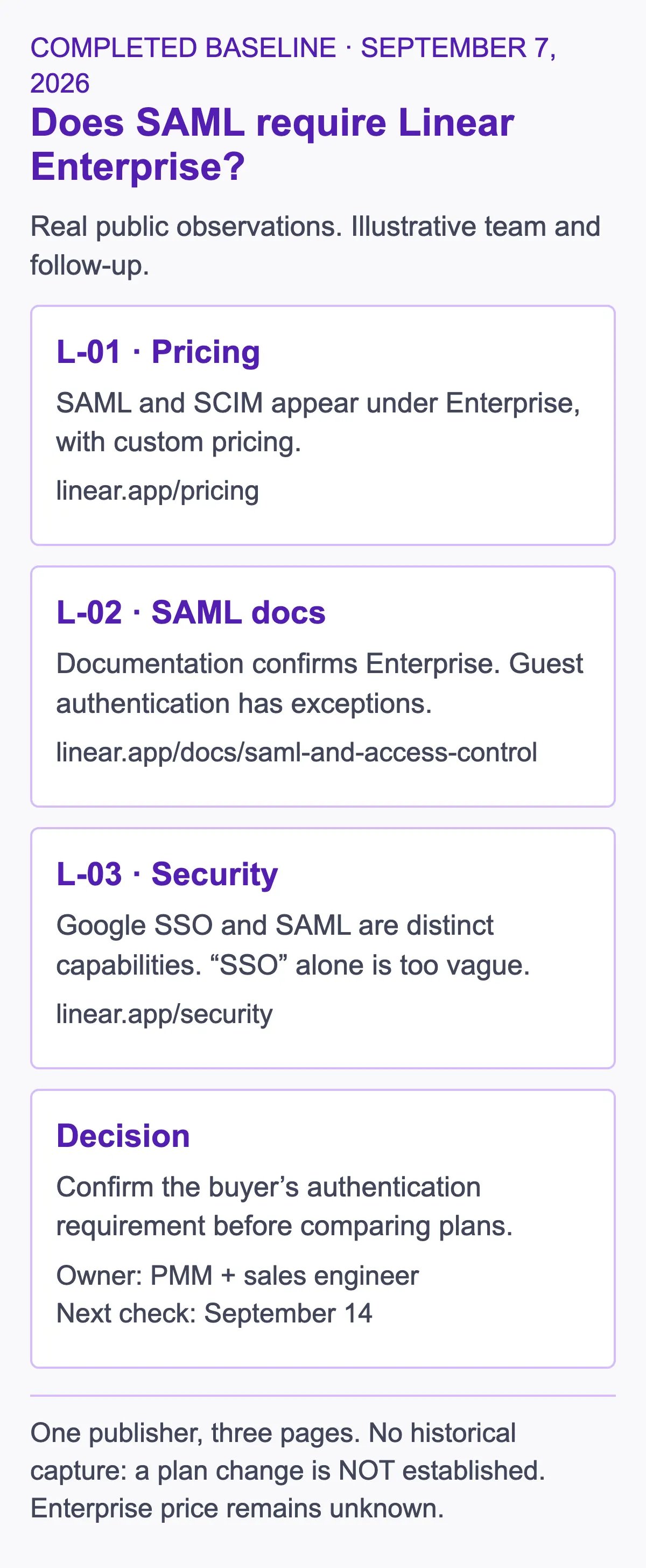
Here is a completed baseline. All three pages were read on September 7, 2026; we did not test Linear or obtain an enterprise quote. A September 8 source recheck confirmed the plan-placement and authentication distinctions used below.
| ID and source | Observed evidence | What it supports | Next check |
|---|---|---|---|
| L-01: Linear pricing | Enterprise lists SAML and SCIM with custom pricing. | The public pricing page places SAML in Enterprise. It does not establish a negotiated price. | PMM, September 14; recheck plan placement before any external comparison |
| L-02: Linear SAML documentation | The documentation says SAML is available to Enterprise workspaces. It distinguishes directly invited guests from guests provisioned through an identity provider. | The documentation corroborates the plan requirement and adds an implementation caveat. | Sales engineer, September 14; preserve the guest-access qualification |
| L-03: Linear security | The page describes Google SSO, SAML, and SCIM as separate capabilities. | “SSO” alone is too broad a label for this comparison. This page doesn’t assign every feature to a plan. | PMM, September 14; use pricing and docs for plan eligibility |
These are three pages from one publisher. Their agreement helps check the consistency of Linear’s public documentation. It is not independent confirmation from three organizations.
The resulting answer is bounded: Linear’s public pricing and SAML documentation place SAML in Enterprise. A buyer requiring it should confirm an Enterprise quote and applicable access rules. We cannot conclude that all Business users lack every form of single sign-on, because Google SSO and SAML are different capabilities.
Nor can we report “Linear moved SAML up a tier this week.” We have no snapshot from before the September 7 baseline showing a different plan placement. The register labels all three observations as a baseline, with change status unknown. That’s a useful outcome: next week’s comparison now has something to compare against.
The plain-text source register includes these completed records and reusable fields. Replace the question and URLs with your own, then keep the observation and inference fields separate.
How do you verify a signal before sharing it?
Open the original source and test the narrowest version of the claim. Record when you accessed it, compare like-for-like captures, and look for an explicit limitation or contradiction. Escalate an observation only as far as its evidence allows. Mark unavailable information as unknown instead of filling the gap with an estimate.
For a pricing signal, hold currency, geography, billing interval, and plan tier constant. A switch from monthly billing to annual pricing can resemble a price cut. A missing page may be a redirect or access failure. Neither is evidence that a product was discontinued.
Use three statuses in your register:
- Verified observation: the source explicitly supports the statement, and you saved enough context for another person to check it.
- Interpretation to test: the observation is solid, but the business explanation remains a hypothesis.
- Unresolved: the page failed, the evidence conflicts, or the question needs information you don’t have.
These statuses attach to claims, not whole websites. L-01 supports the advertised Enterprise plan placement for SAML with high confidence. The same page gives us no confidence about a specific buyer’s enterprise discount.
Give each verified claim a review-by date. If that date passes, mark it overdue and pause reuse in comparison pages or sales guidance until someone rechecks it. Expiry does not mean the old observation was false; it means you no longer have a current verification. Keep the dated evidence, and notify anyone using a claim that has been withdrawn or contradicted.
When sources disagree, preserve both. Suppose next week’s pricing page includes SAML in Business while the docs still say Enterprise. Record the discrepancy, pause the external comparison claim, and seek clarification through an ordinary permitted channel. Don’t choose whichever page makes your company look better.
AI can help extract fields from the captures you supply. Ask it to return the source ID beside each observation and mark missing fields as unknown. The reviewer still opens the evidence. A fluent summary is not a second source, and several summaries of the same announcement aren’t corroboration.
How do you gather competitive intelligence on a weekly schedule?
Reserve a weekly review block after you’ve set up the sources. Check collection failures first, inspect meaningful differences, verify the claims that could affect a decision, and hand off only those findings. End by recording who will act and which sources need another check. A quiet week can legitimately produce no change.
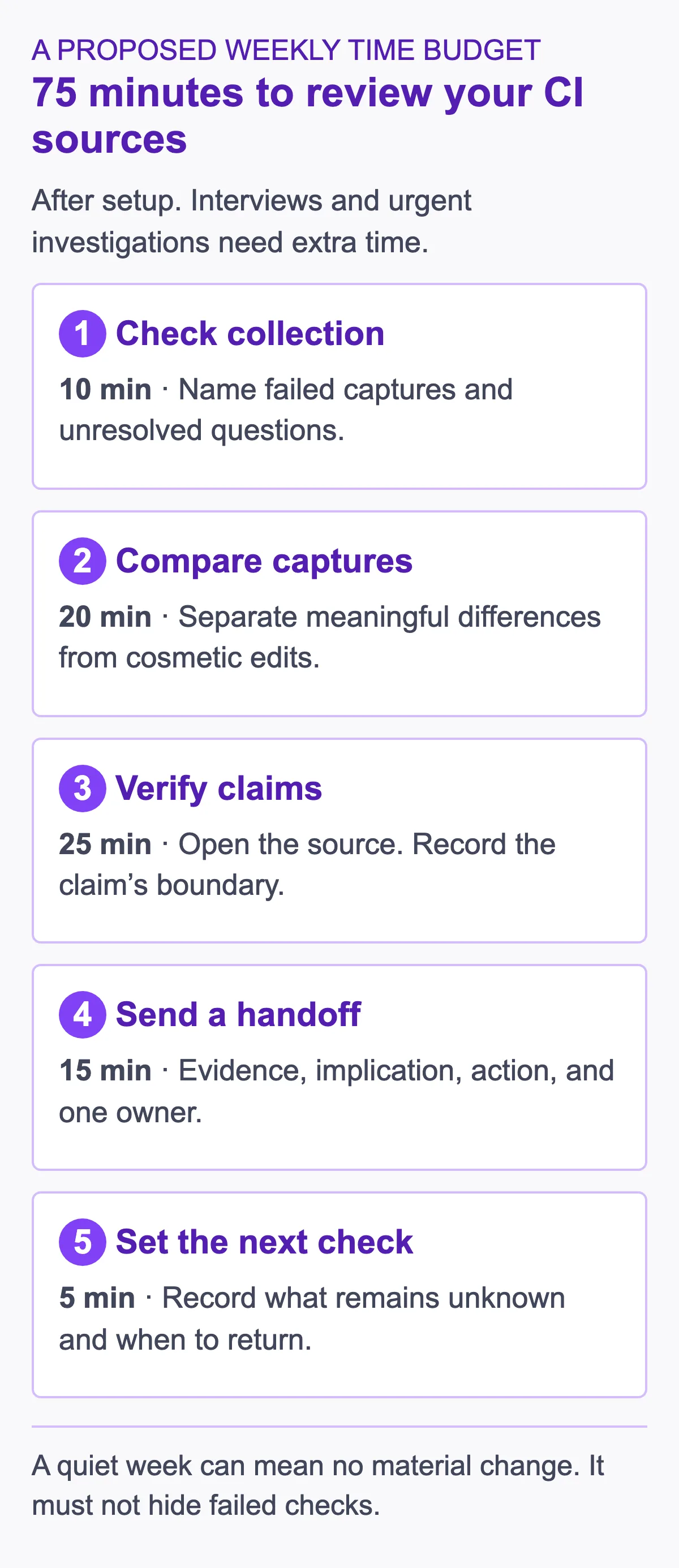
The following 75-minute block is a starting time budget for an established watchlist. Initial setup, interviews, and urgent investigations take additional time. If the routine repeatedly overruns, reduce coverage or allocate more review time before buying more alerts.
| Time budget | Work | Done when |
|---|---|---|
| 10 minutes | Check capture failures and the question list | Every priority source is either checked or explicitly unresolved |
| 20 minutes | Inspect new captures against the baseline | Each candidate has a source ID; cosmetic changes are dismissed |
| 25 minutes | Verify candidates against docs or permitted internal evidence | Each claim has a status and a clear boundary |
| 15 minutes | Write a short handoff for the decision owner | The reader can see the evidence, implication, and requested action |
| 5 minutes | Close the loop and set next checks | The register records the owner, due date, and unresolved questions |
For the Linear example, the first handoff could read:
Question: Does a SAML requirement change the plan a buyer should compare? Evidence: L-01 and L-02 place SAML in Enterprise; L-03 distinguishes SAML from Google SSO. Action: Compare the buyer’s actual authentication requirement before quoting Business pricing. Ask for an Enterprise quote when SAML is required. Boundary: This is a September 7 baseline, not evidence of a recent pricing change. Owner: PMM, with a sales engineer checking the wording before the next comparison update.
A product announcement affecting an active evaluation shouldn’t wait for the weekly block. Verify it, send a targeted update to the deal owner, then add it to the register. The weekly review block is for routine maintenance; urgency depends on the decision deadline.
After four cycles, review your sources. Keep a rarely changing security page if it answers a recurring procurement question. Remove a noisy feed that never informs a decision. Count unresolved captures and completed checks, not just the number of alerts collected.
For longer analysis, reuse the register as the evidence behind a competitive intelligence report. The report can change by audience while the source IDs remain stable.
What should you do with an empty or uncertain week?
Report the coverage and the uncertainty. “No material changes in the eight pages we successfully checked” is useful. “Competitor X did nothing” goes beyond the evidence. If two sources failed, name them and give the next check an owner. That prevents a collection failure from masquerading as a quiet market.
The first week often produces corrections to your own assumptions. In our example, the most useful finding was that “SSO available” is too vague for a plan comparison. No dramatic competitor move was required.
Choose one buying question, copy the register, and establish your baseline. Keep next week’s appointment even if there are no exciting alerts. That’s how to gather competitive intelligence your colleagues can return to and check for themselves.
For an example of the next stage, read our completed competitor analysis, where collected evidence becomes a comparison matrix and sales guidance.