
A competitor edits its pricing page. Before briefing sales, you need to know whether buyers face a different offer or you’re looking at a rewritten sentence.
Jev, TypeSafe’s decision model, offers a possible triage layer for competitive intelligence (CI). The four workflows below are illustrative designs based on its documentation, not tested integrations. We haven’t run Jev on Unkover data or called its API for this article.
Where does Jev fit in competitive intelligence?
Place Jev after evidence collection and before a person’s decision to act. Feed it relevant text and narrowly defined questions, then use its typed answers to organize a review queue. Your competitive intelligence process still needs someone accountable for interpreting the evidence and deciding what sales should hear.
The TypeSafe primitives documentation defines Choice for one category, Score for a position on an ordered rubric, and Noul for the probability of a yes answer. Questions share the supplied context but are evaluated independently; one answer doesn’t silently inform another.
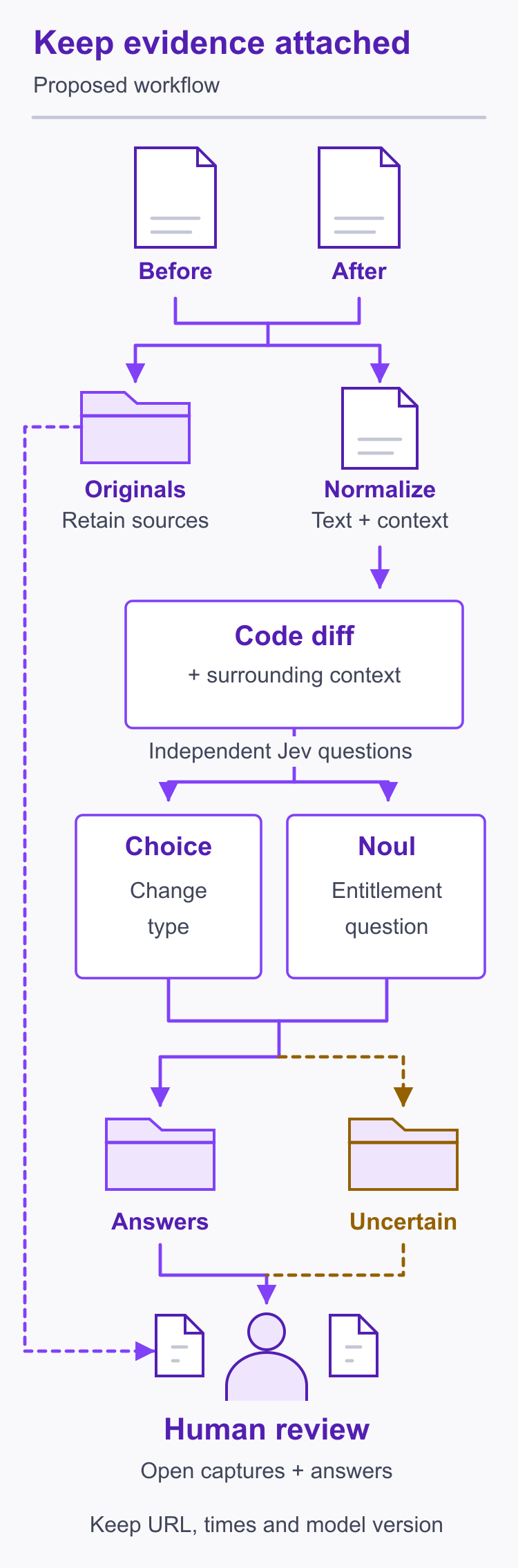
Collection remains the job of your competitor monitoring tools. Fetch pages, normalize their text, compute changes in code, and retain the surrounding context. Jev receives that evidence; it doesn’t replace the collection workflow.
Did the pricing or feature change matter?
Ask what changed separately from whether it affects a buyer. A pricing label, feature entitlement, and wording edit are different change types; none alone tells you how consequential the change is. Supply both versions with plan names, billing terms, currency, and nearby qualifications before asking Jev to classify it.
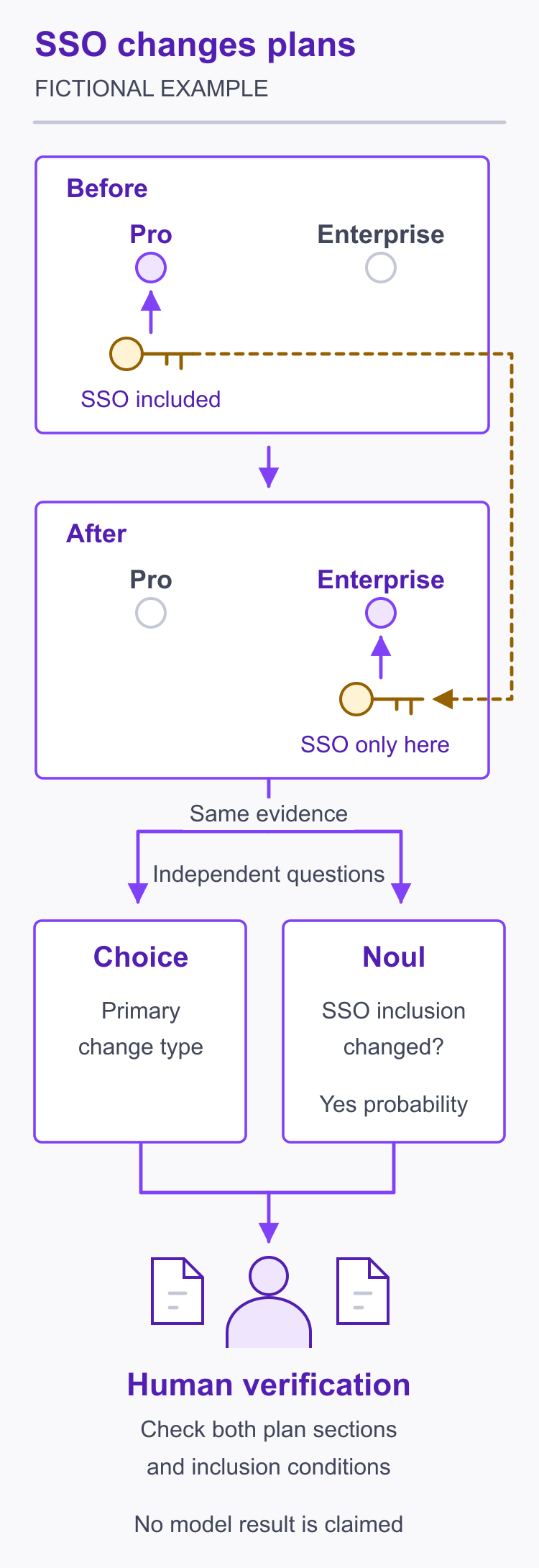
Consider this fictional feature-page change: yesterday, the Pro plan included single sign-on (SSO); today, the page lists SSO under Enterprise only. The useful input is both plan sections and their headers, not two isolated occurrences of “SSO.” Compare like-for-like captures, including the same billing toggle and locale.
Start with a Choice question: “What is the primary change: price or billing terms, feature entitlement, wording only, or other/unclear?” It returns one category, not every possible change. Split unrelated changes into separate evidence records rather than forcing a mixed page update into one label.
Then ask a separate Noul question: “Does the new text change which plan includes SSO?” Define yes as a changed inclusion condition, and no as wording that preserves the same entitlement. The output is a yes probability, not a severity score.
If you need severity, define a separate Score rubric for the affected buyer: unchanged access, access with additional conditions, or loss of access on the current plan.
For this illustration, a changed entitlement warrants review by product marketing. The reviewer opens both captures, checks the qualification, and decides whether the battlecard needs an update. Ambiguous captures also go to review; a missing section or failed fetch is a collection problem, not evidence that nothing changed. Keep the source URL, capture times, and model version with the record.
Which changelog entries deserve a closer look?
Evaluate one entry against an explicit customer profile and product scope. A release can matter to your buyers without deserving an immediate sales alert. Give Jev the announcement, its source, and the customer requirement you care about; ask about that requirement rather than whether the release is generally “important.”
For a team selling to multi-location operators, a Noul question could be: “Does this entry explicitly announce controls for managing multiple locations?” Its yes probability helps prioritize inspection, not establish that the capability works as advertised. A reviewer checks availability and restrictions, then routes the source to product for comparison, product marketing for positioning, or sales when a verified change affects an active objection.
What themes recur in public reviews?
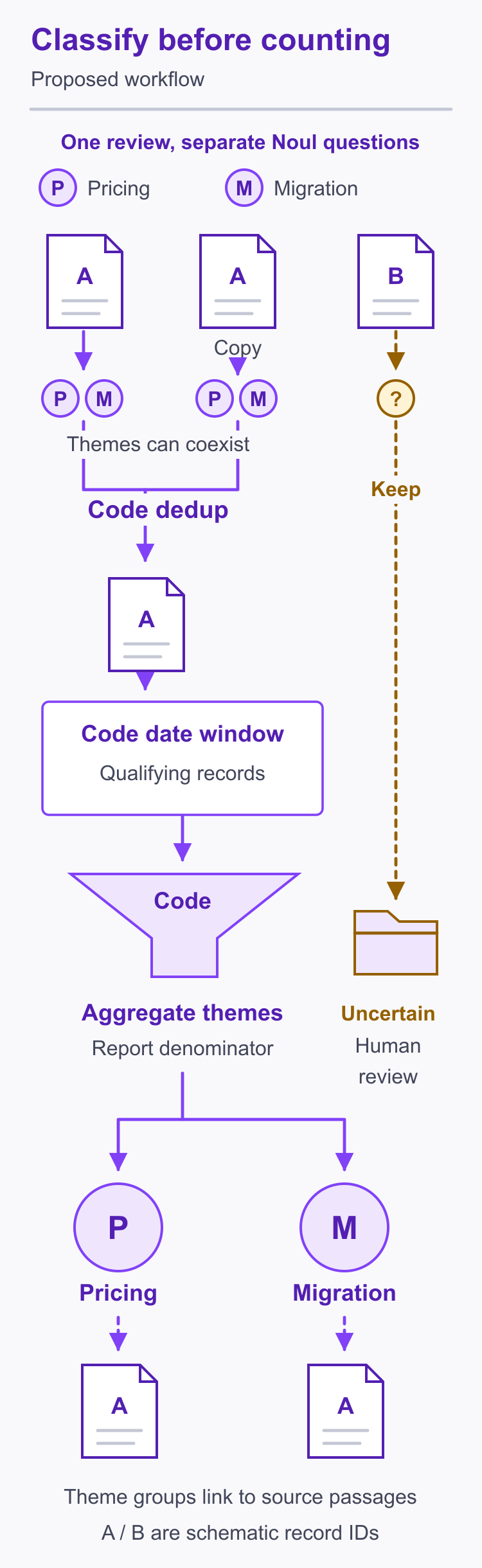
Classify each review before calculating patterns across the collection. Supply one review, its source, and predefined theme definitions. Use separate Noul questions for themes that can coexist, such as pricing complaints and migration difficulties. A single Choice would force a review mentioning both into only one category.
For example, ask: “Does this reviewer explicitly describe difficulty moving data into the product?” Store the answer alongside the original passage. Code should deduplicate records, apply the date window, and count qualifying classifications; show the denominator and keep uncertain items separate.
A product marketer can inspect the passages behind a recurring complaint before proposing follow-up research. Those counts describe your collected reviews, not the entire customer base.
What does a job ad explicitly tell you?
Treat a job advertisement as evidence of what the posting says, not a window into unannounced strategy. Supply the full relevant passage and ask separate Noul questions about named segments, geographies, or skills. Preserve the posting URL and quoted evidence so a person can inspect the interpretation.
“Does this role explicitly serve healthcare customers?” is bounded. “Is this company pivoting into healthcare?” isn’t. Likewise, a requirement for German-language support doesn’t prove a new German launch. A CI owner can add the explicit statement to a watchlist and look for corroborating evidence without turning it into a strategic conclusion.
What should Jev leave to your competitive intelligence team?
Keep arithmetic, date comparisons, and final interpretation outside the model. TypeSafe documents limitations involving numbers, context, and adversarial inputs. Treat competitor text as untrusted data, not instructions. Its confidence guidance calls for thresholds tested on your own cases; reported confidence isn’t measured accuracy on competitor pages.
Noul supplies a yes probability without a separate confidence field. Choice and Score include distributions and confidence; don’t treat these different outputs as interchangeable.
As checked September 26, 2026, TypeSafe lists jev-1.13.0 at $0.042 per million input tokens, with free outputs. Hypothetically, 5,000 total input tokens, including questions, cost 5,000 x $0.042 / 1,000,000 = $0.00021 per check. At 10,000 identical checks, that’s $2.10 for inference only, excluding fetching, rendering, retries, storage, taxes, downstream models, and human review. This is arithmetic, not measured usage or a workflow budget.
Start an evaluation with pricing and feature changes, where you can retain both versions and have a person label the result. Keep material and uncertain cases visible until reviewed. For the broader AI competitive intelligence workflow, Jev’s proposed role is a bounded decision step, with evidence still attached when your team acts.